How Private Equity Firms Find Local Businesses for Acquisition

Table of Contents

Private equity firms looking for local acquisition opportunities need more than a list of company names. They need a repeatable way to define the market, find relevant businesses, research ownership, and narrow hundreds of companies into a smaller group worth investigating.

Targetron can support the early research stage by helping teams narrow and export local business records by category, location, and other available criteria. After export, researchers can verify the businesses, study ownership and market position, and move stronger candidates into deeper acquisition research. 

Important Note: A business appearing in a dataset does not mean it is for sale, financially attractive, or suitable for acquisition. Ownership interest, financial quality, valuation, and investment fit require separate research and due diligence. 

Build Your Local Acquisition Research List

Define your target market, narrow relevant businesses, and export records for deeper acquisition research.

Quick Answer: How Can You Use Cold Email and Lead Generation to Find Potential Clients?

  1. Define the investment thesis.
  2. Map the relevant local market.
  3. Screen businesses using observable information.
  4. Export and enrich the business dataset.
  5. Prioritize stronger thesis fits for outreach and diligence.

1. Define the Acquisition Thesis First

Start by deciding what type of business fits the investment strategy.

Useful criteria include:

  • Industry
  • Geography
  • Business model
  • Ownership profile
  • Approximate company size
  • Customer type
  • Geographic footprint
  • Platform or add-on potential

For example:

Industry: HVAC
Geography: Texas
Business Type: Independent operators
Strategy: Platform or add-on research
Research Focus: Ownership, locations, company scale, and market presence

This gives the research team a clear starting point instead of searching for random businesses. 

Turn the Thesis Into Search Criteria

Convert the investment thesis into practical research questions:

  • Which industries fit the strategy?
  • Which cities matter?
  • Are single-location or multi-location companies more relevant?
  • Should the research focus on independent operators or regional groups?
  • What characteristics would justify deeper research?

For specialized markets, Targetron’s guide to finding B2B leads in niche industries provides another way to structure market research. 

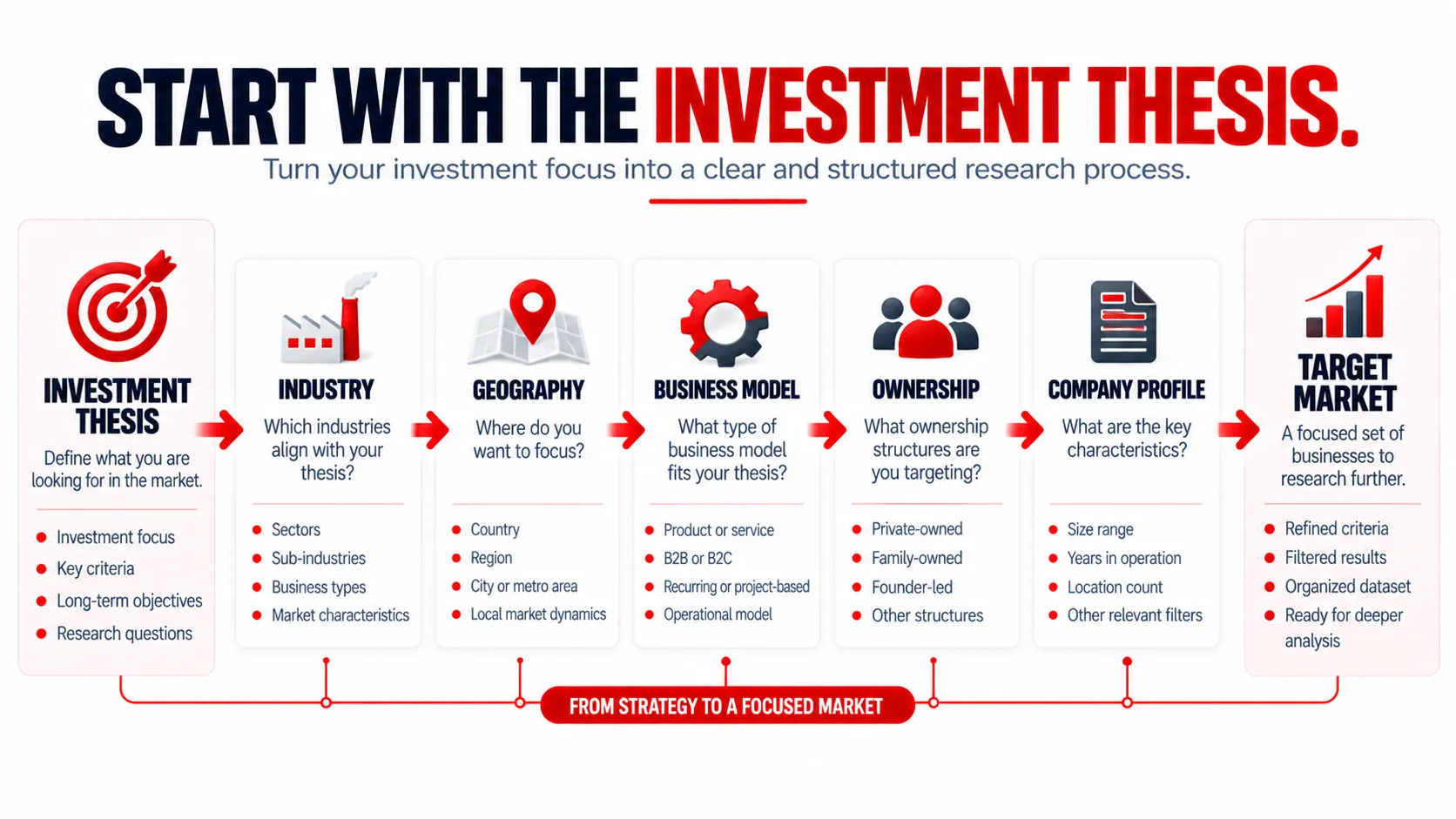
Private equity investment thesis narrowed by industry, geography, business model, ownership, and company characteristics.
Define the acquisition criteria before building the target universe.

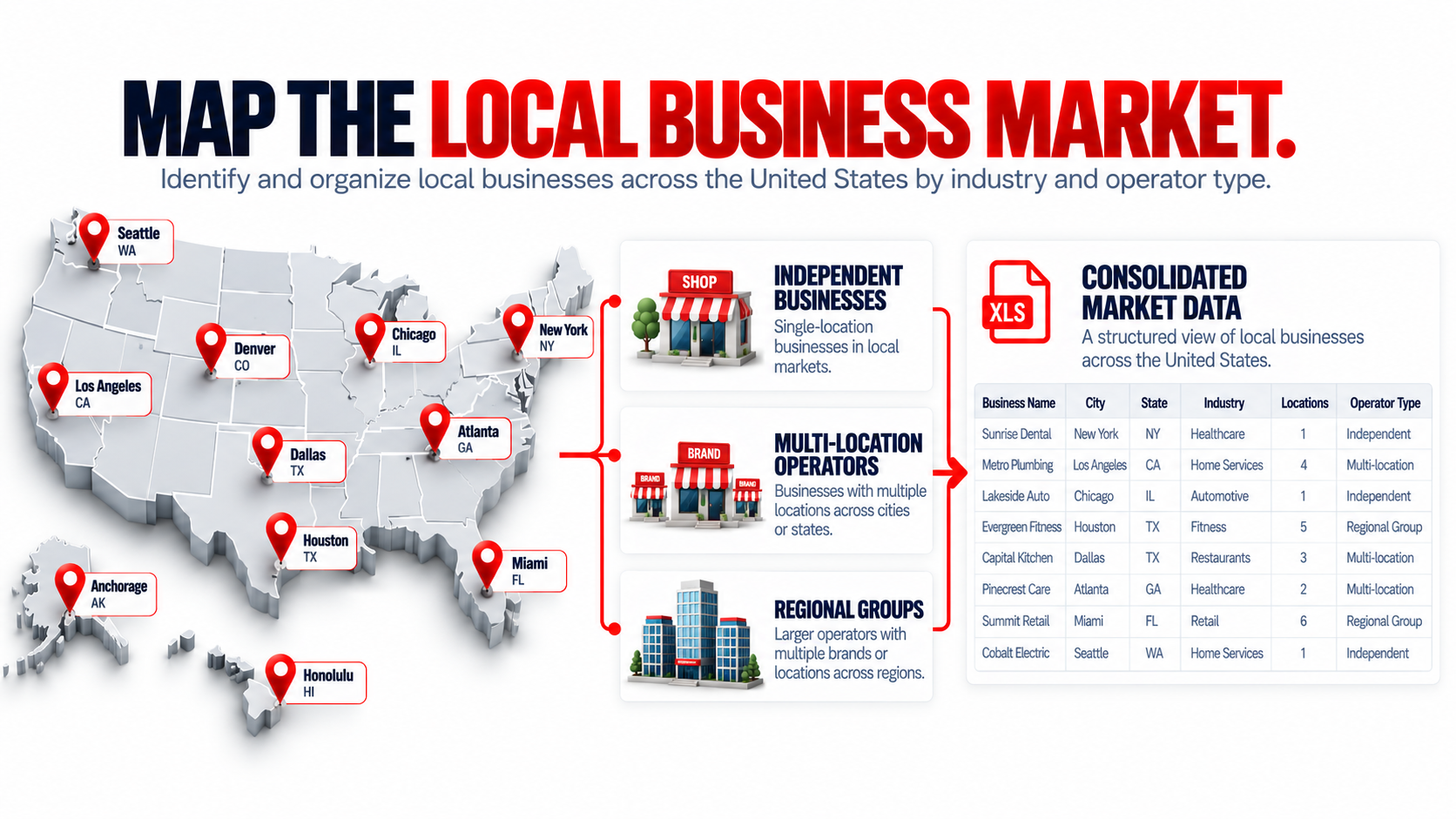
2. Map the Local Business Market

Once the thesis is clear, build a broad view of the market.

A local industry may include:

  • Independent businesses
  • Family-owned companies
  • Multi-location operators
  • Regional groups
  • Smaller competitors
  • Businesses concentrated in specific cities

Organize the market using a simple structure:

State → City → Business → Locations → Research Status

This helps reveal where relevant businesses are concentrated before the team spends time researching individual companies.

Look for Market Structure

Ask practical questions:

  • Which cities contain the most businesses?
  • Is the market fragmented?
  • Are most companies independent?
  • Which businesses operate multiple locations?
  • Are regional groups already forming?
  • Which areas deserve deeper research?

The goal is not to select an acquisition immediately. It is to understand the market first.

Targetron’s Business Directory can support broader local-market research. 

Local business market organized by city, independent businesses, multi-location operators, and regional groups.
Map the market before deciding which businesses deserve deeper research.

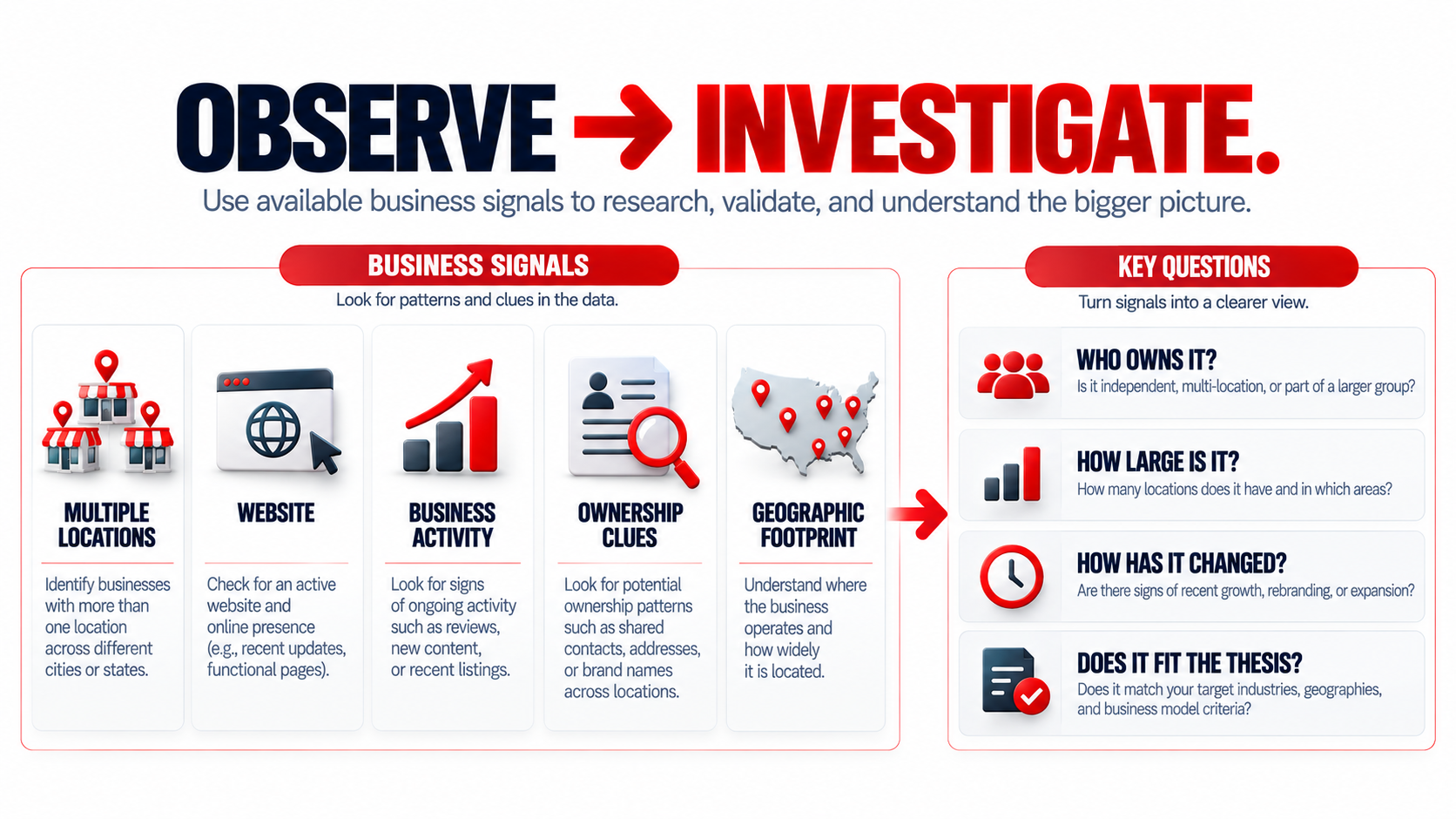
3. Screen Businesses Worth Investigating

The next step is narrowing the broad market into companies worth researching further.

Useful information can include:

  • Business category
  • Location
  • Number of locations
  • Website information
  • Public business history
  • Management information
  • Ownership clues
  • Review activity
  • Geographic footprint
  • Public company announcements 

Turn Observations Into Research Questions

If a business has five locations, ask:

  • When did those locations open?
  • Are they owned by the same company?
  • Has the footprint expanded recently?
  • Who owns the business?
  • Is it independent or part of a larger group?

If a business has operated in the same market for years, research its ownership, leadership, reputation, and position in the local industry.

Observable information should create questions, not conclusions.

A structured commercial due diligence framework can also help later when evaluating market position, competition, and strategic fit. 

Observable local business information converted into ownership, scale, expansion, and acquisition-fit research questions.
Use business information to decide what deserves deeper investigation.

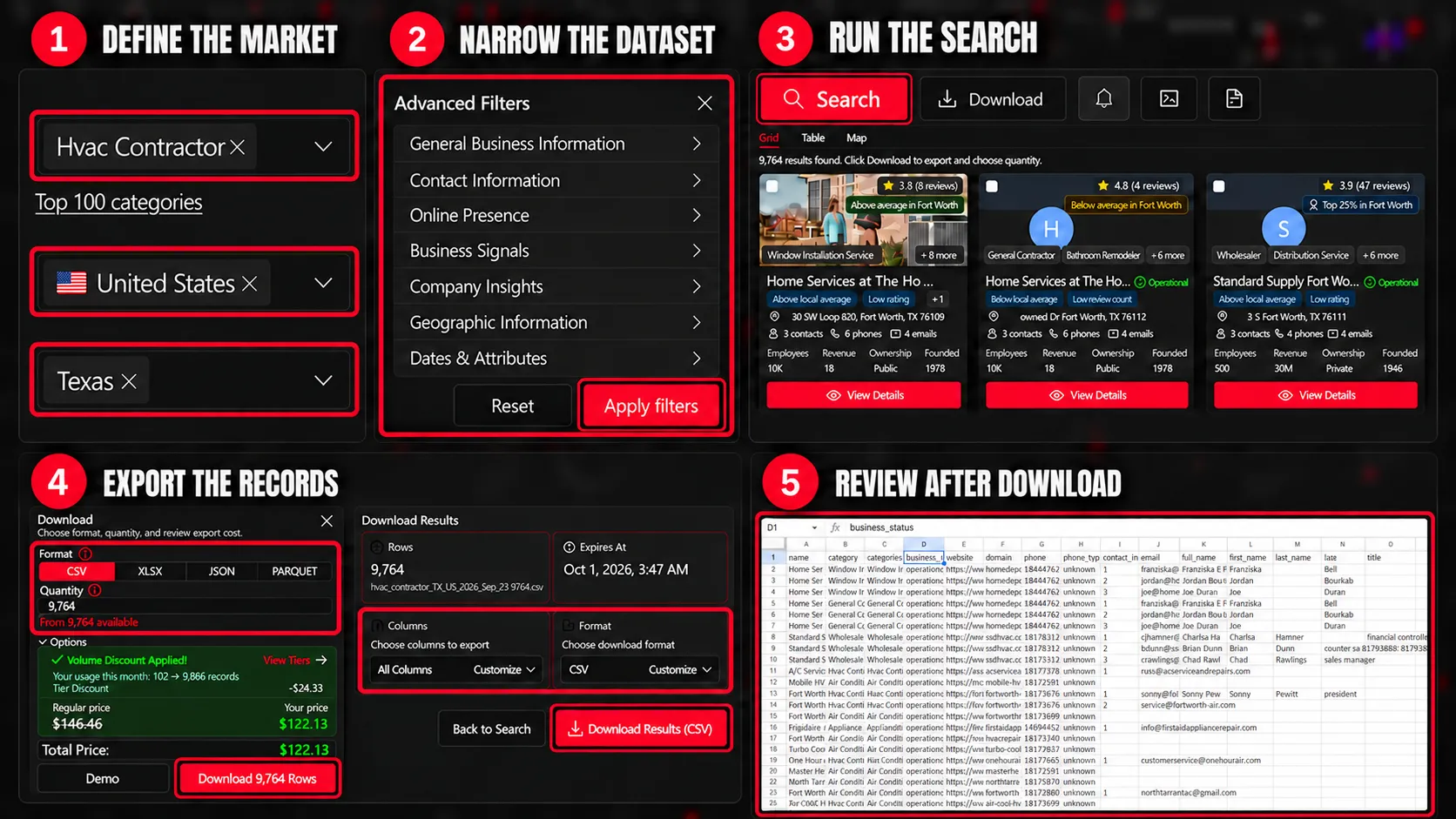
4. Use Targetron to Build the Initial Business Dataset

Targetron can support the market-mapping stage by helping researchers narrow local business records.

The workflow is simple:

Category → Location → Relevant Filters → Search → Export

Advanced Filters, Contact Information, and Online Presence criteria can be used when they support the research goal.

After setting the criteria, run the search and proceed to Download.

Individual business information is reviewed after export.

The export workflow is:

Download → Format → Quantity → Columns → Download Results

Once downloaded, the dataset becomes the starting point for company-level research. 

Targetron Business Catalog workflow showing category, location, filters, search, and export for private equity market research.
Narrow and export the business universe before company-level acquisition research begins.

What Targetron Does in the Process

Targetron helps with the discovery and dataset-building stage.

It does not determine:

  • Seller interest
  • Revenue
  • Profitability
  • Enterprise value
  • Management quality
  • Debt capacity
  • Legal risk
  • Investment suitability

Those questions require deeper research.

For additional business-data research, see Targetron’s local business contact data

Turn Your Investment Thesis Into a Dataset

Define your target market, narrow relevant businesses, and export records for deeper acquisition research. 

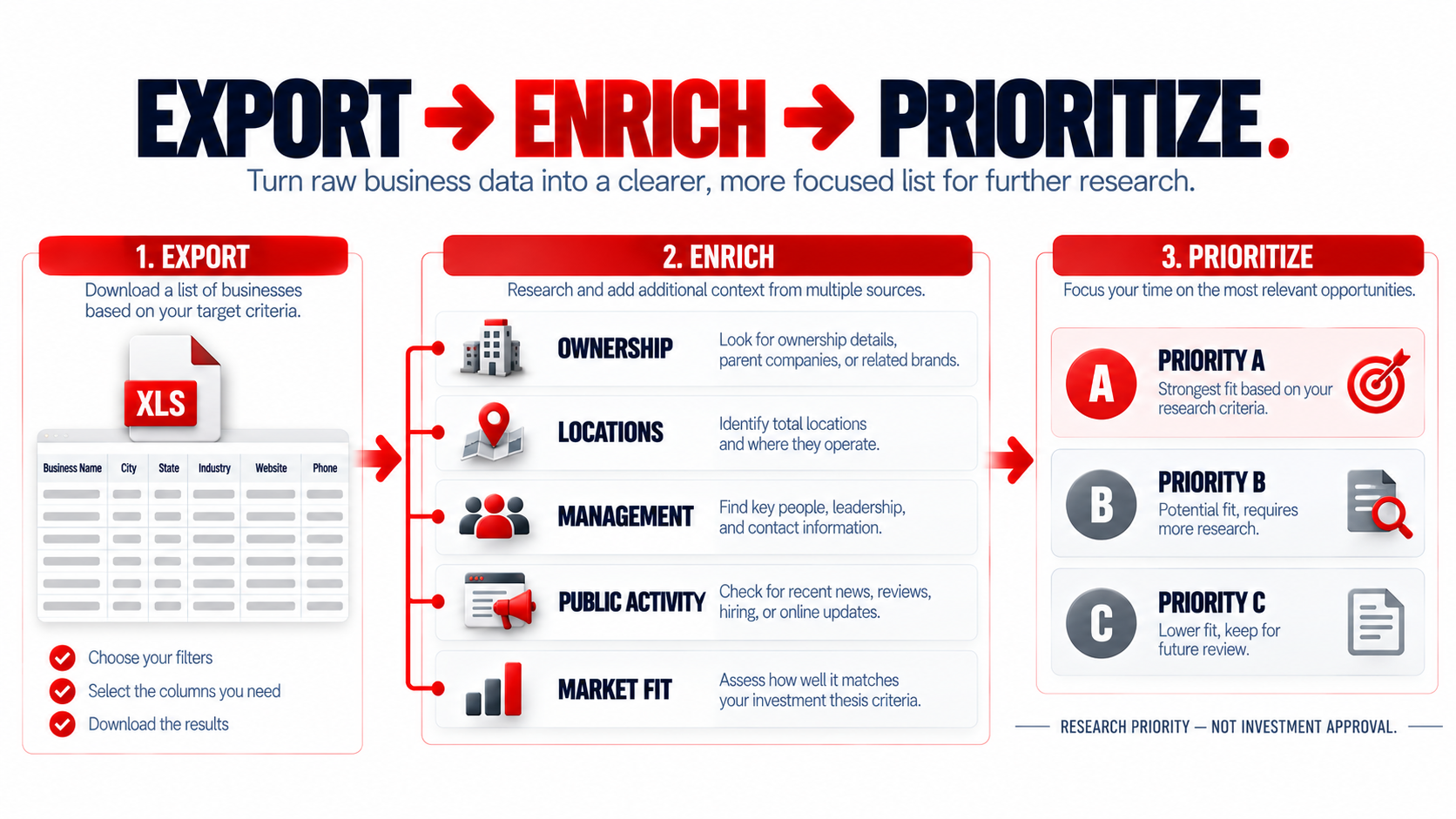
5. Enrich and Prioritize the Exported Businesses

Open the exported file and begin researching individual companies.

Useful additional sources include:

  • Company websites
  • Business registries
  • Professional profiles
  • Industry directories
  • Hiring pages
  • Local news
  • Company announcements
  • Public filings when available

Add the findings directly to the working research list.

For example:

Business: ABC Services
Industry: HVAC
Market: Dallas
Locations: 4
Ownership: Founder-led
Public Activity: Additional location announced
Thesis Fit: Further research
Next Step: Ownership and financial research

Prioritize the Research List

A simple system can keep the pipeline manageable:

Priority A: Strong thesis fit; deeper research justified

Priority B: Possible fit; more information needed

Priority C: Limited fit with the current strategy

These are research priorities, not investment recommendations.

Targetron’s lead scoring guide can provide ideas for organizing consistent criteria across a larger research list. 

Exported business records enriched with ownership, locations, management, public activity, and market-fit information.
Add deeper research before deciding which businesses deserve more attention.

6. Move Stronger Targets Toward Outreach and Due Diligence

Once a company passes the initial research stage, investigate the areas that matter to an acquisition.

These may include:

  • Ownership structure
  • Management
  • Market position
  • Customer profile
  • Revenue quality
  • Profitability
  • Customer concentration
  • Working capital
  • Operational risks
  • Legal issues
  • Potential valuation
  • Strategic fit 

Research the Owner Before Outreach

Before contacting the business, determine:

  • Who owns the company?
  • Is the founder still involved?
  • Is ownership concentrated?
  • Has the company raised outside capital?
  • Is there any public evidence of succession planning?
  • Has the company entered a sale process?

If no evidence exists, do not assume the owner wants to sell.

Keep Acquisition Outreach Simple

A first message can be direct:

We have been researching independent HVAC businesses in Texas as part of a long-term investment strategy and came across your company while studying the Dallas market. I would be interested in learning more about the business and your long-term plans if you would be open to a conversation.

The purpose is to open a conversation, not assume a transaction.

Move Into Formal Diligence

If discussions progress, deeper review may include:

  • Financial statements
  • Contracts
  • Customer concentration
  • Tax matters
  • Employees
  • Liabilities
  • Operations
  • Management
  • Legal issues
  • Commercial risks

Once a business moves beyond initial sourcing, deeper review can cover financial performance, tax exposure, operations, technology, and other transaction risks through a structured due diligence process.

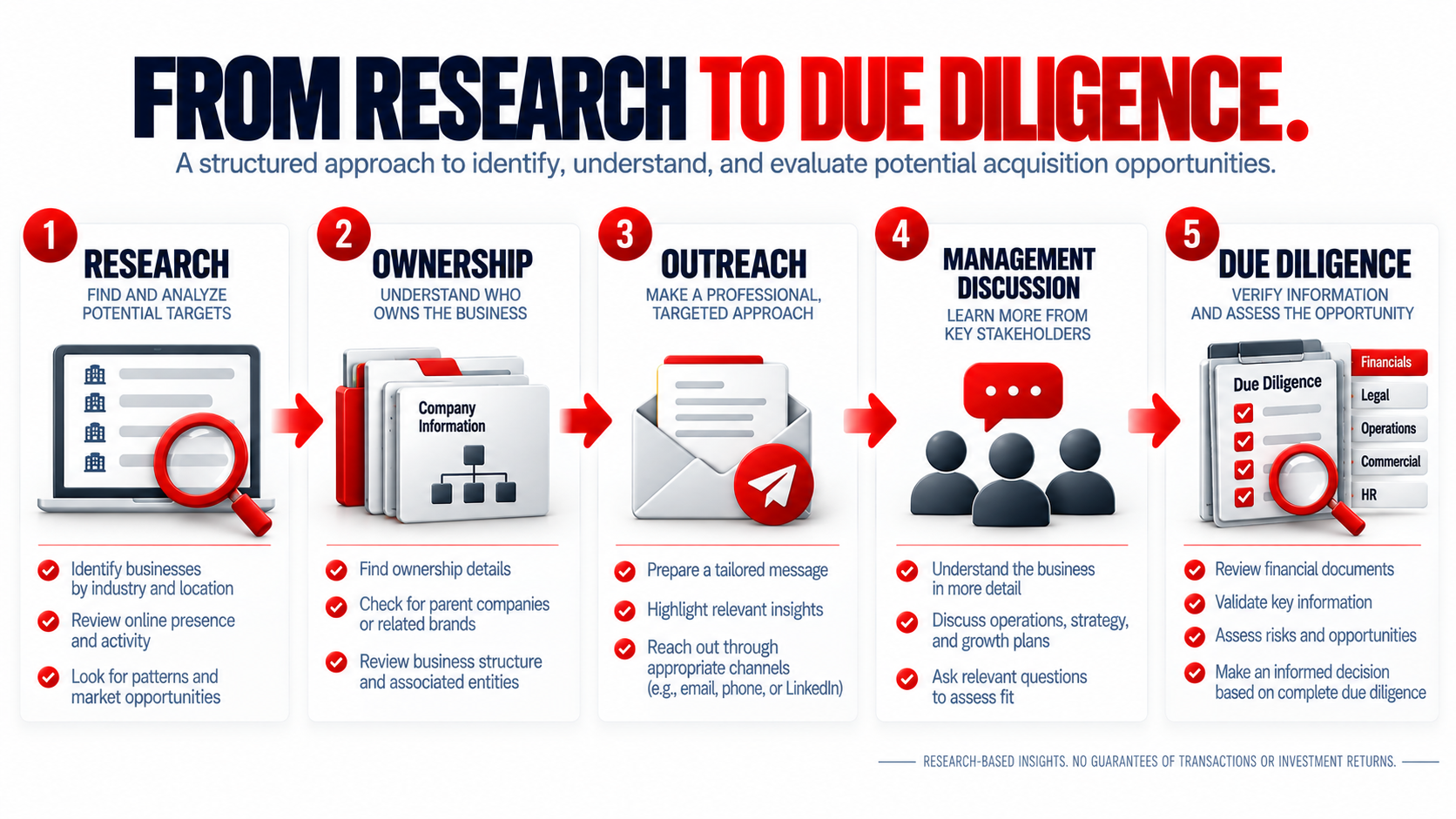
Private equity acquisition process moving from business research and ownership analysis to outreach and formal due diligence.
Deeper diligence begins after a business moves beyond the initial research stage.

Find the Businesses Worth a Closer Look

Use Targetron to narrow the local market, export relevant business records, and build a stronger starting point for deeper acquisition research. 
FAQ

Most frequent questions and answers

They can combine market mapping, business databases, industry relationships, referrals, brokered opportunities, and direct research.

Usually industry, geography, company type, ownership characteristics, scale, and strategic fit. 

No. Targetron helps narrow and export business records for research. Seller interest requires separate verification.

No. Multiple locations are a research signal that may justify investigating ownership, scale, and expansion history. 

After enough research has been completed to explain why the business fits the firm’s investment strategy.

The firm can conduct deeper ownership, financial, operational, commercial, and legal research before making an investment decision. 

Written by