Arrange a Free Consultation.
Get Free Expert Advoce
Don't wait for a call. Chat with our sales team now via WhatsApp!
Real estate leads are the starting point for every sale. In 2025, U.S. existing home sales ran at about 4.06 million transactions for the year, according to housing market data from the National Association of Realtors and market aggregators.
That number shows how large the opportunity is. But most agents see only a fraction of that potential because they focus on getting more leads instead of understanding how leads work.
In this guide, we’ll walk through how real estate leads actually work, where to find both inquiries and property owners, and how to turn them into clients, not just contacts you store.

A real estate lead is a person who has shown interest in buying, selling, or investing in property. They might fill out a valuation request, ask about listing, inquire about financing, or be a homeowner identified through property records. Actual interest can range from early research to immediate intent.
Once a lead enters your prospect path, it goes through a simple flow:
Each step determines whether a lead becomes income or stays as a name on a list.
There are different lead models that agents work with:
Understanding these models helps you choose the right approach for your business and your budget. Most agents benefit from a mix of these sources, so they are not dependent on a single platform or lead type.
Even with good sources, many agents struggle to convert leads because of slow responses, poor tracking, inconsistent follow-up, or buying leads without knowing the cost per closing. Conversion isn’t about volume alone. It is about managing the process clearly and consistently.
Now that the process is clear, the real question becomes practical: where do you actually find consistent real estate leads?
Let’s break down paid providers, local organic channels, and data-driven sources.
Once you understand how real estate leads work, the next step is choosing the right source. Most agents rely on paid platforms, local visibility, or direct data access. Each option offers different levels of speed, cost, and control.
Let’s break them down.
Many agents start with a real estate leads provider because it offers speed. You pay, and inquiries arrive. These platforms perform best when you respond within minutes, track every inquiry in a CRM, and measure both bost per lead and cost per closing.
They tend to fail when leads sits uncalled for days or when agents never audit which sources actually turn into signed clients.
Here are some of the most common platforms:
Choosing the right real estate leads provider depends on your follow-up speed, budget, and ability to track cost per closing. Paid leads can work well if managed with discipline.
Local search connects directly to buyer and seller intent.
Key Sources include:
A simple starting point is a neighborhood guide or “living in [Neighborhood] page that ranks for local searches and links to your listings. Pair that with well-optimized GBP, and you can capture both discovery searches (“best real estate agent in…”) and branded name searches.
When someone searches locally, intent is often high. Ranking in those searches brings consistent inbound real estate leads.
Free leads require time instead of money.
Main channels:
These methods build momentum slowly but strengthen long-term relationships. For your sphere and referrals, a simple cadence works: quarterly check-in emails, a monthly market update, and personal outreach around major life events or anniversaries.
The goal is to stay relevant without feeling like you’re constantly pitching.
A real estate leads database gives agents direct access to property-related businesses and decision-makers. Tools like Targetron provide structured B2B directory data across real estate businesses in the USA market.
This approach works well for commercial outreach, investor targeting, property management partnerships, and off-market sourcing.
There are several ways to find real property owners directly, using public data, intent-based listings, and ownership patterns.
Buying inquiry-based real estate leads is one approach. Targeting property owners directly is another.
When you reach ownership-level data, you control the list. You decide who to contact, when to reach out, and how to position your offer. This method works well for listing-focused agents, commercial brokers, and investors looking for off-market opportunities.
Property ownership information in the US is publicly recorded at the county level. These records provide verified ownership details tied to specific parcels.
Public records require manual work, but the data is accurate and ownership-based.
For agents focused on listings, FSBO and expired properties often convert at higher rates.
Several services provide updated FSBO and expired lists. These tools collect and organize public listing data, saving research time. Success depends on quick contact and a clear value proposition.
Absentee owners and property investors represent strong listing opportunities. They include out-of-state owners, rental portfolios, and pre-foreclosure properties.
Targeting these groups works best when combined with accurate contact details and consistent follow-up.
Generating real estate leads for agents is only part of the process. Conversion requires speed, structure, and consistent follow-up. A clear system ensures opportunities are not lost.
Speed increases engagement.
Example:
“Hi, this is [Your Name]. I saw your request and wanted to quickly see how I can help.”
Research consistently shows that faster response times significantly improve contact and appointment rates. The goal of the first interaction is to start a conversation, not close a deal.
Not every lead is ready immediately. The qualifications framework helps you prioritize.
Focus on:
Try to answer the above-mentioned questions. Your answer will determine whether the lead is short-term or long-term.
Most leads require multiple touches before committing.
Just try to build a simple system:
Short-term leads may need weekly contact. Long-term leads can be nurtured monthly. Your consistency builds familiarity and trust, which increases conversion over time.
Generating and converting leads is only effective if your data is organized and measurable. A structured database allows you to track performance, improve targeting, and make informed budget decisions.
Whether you generate real estate leads for agents through public records, paid sources, or direct outreach, everything should flow into one central system.
Your database should capture both contact and qualification details.
At a minimum, include:
Recording the source is critical. It enables you to compare performance across channels and identify which lead types result in actual closings.
A complete database improves follow-up accuracy and long-term tracking.
Without tracking metrics, it is difficult to scale effectively.
Key performance indicators include:
For example, lower-cost leads may appear efficient but produce fewer closings. Higher-cost leads may convert at a stronger rate. Measuring both lead volume and closing performance provides a clearer picture.
Data-driven decisions improve marketing allocation and reduce wasted spend.
When working with real estate leads for USA providers, the targeting strategy affects cost and competition. Using location intelligence tools allows you to filter decision-makers by ZIP code, county, or metro area, giving you more control over geographic targeting and competition levels.
In high-demand ZIP codes, competition increases the cost per lead. In secondary markets, costs may be lower, but volume may be smaller.
You should consider:
National targeting offers scale. Local targeting allows focus and specialization. Your database should track geographic performance so you can adjust spending based on measurable results.
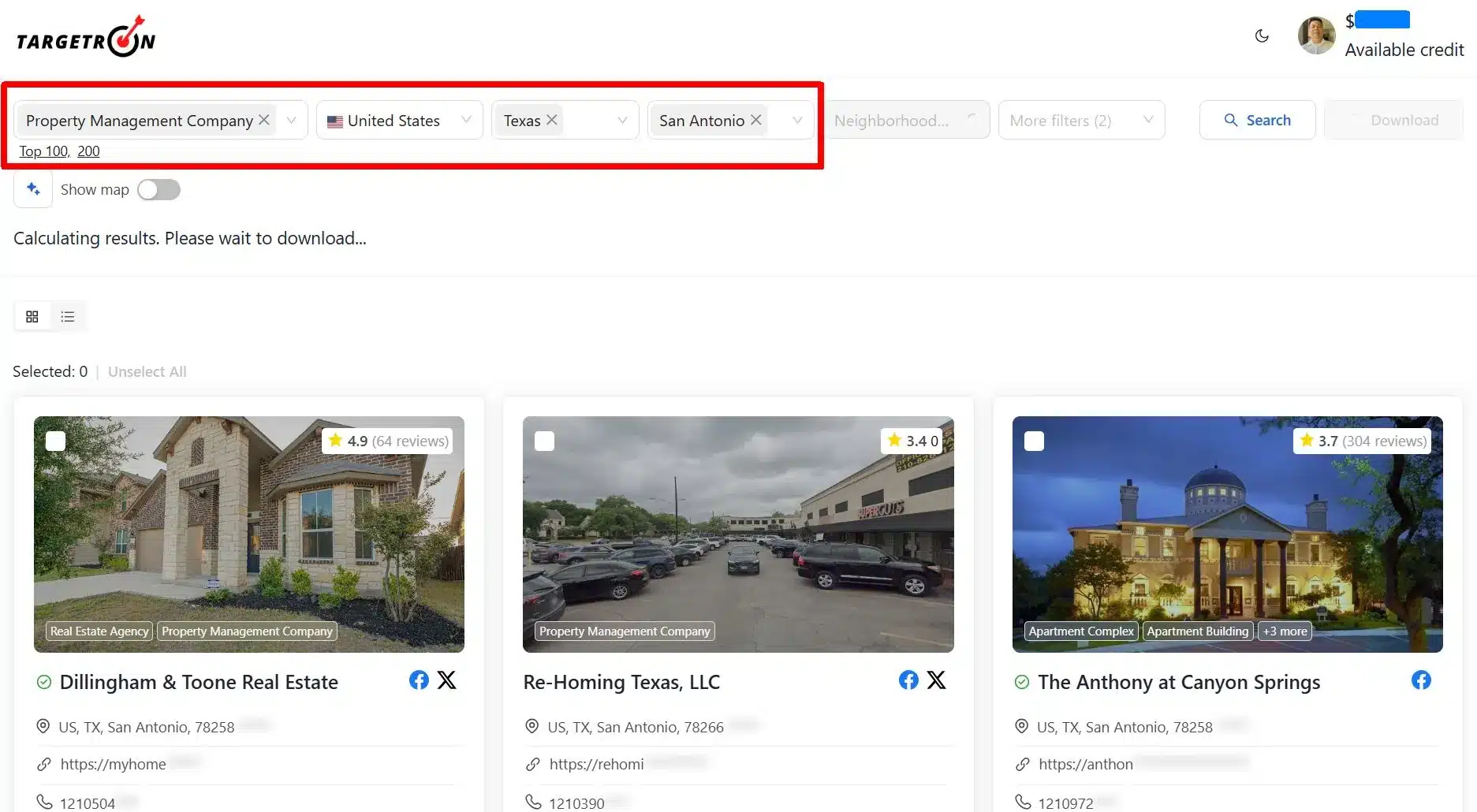
Once you understand how leads work and which sources fit your strategy, the next step is to build a clean, owner-focused database you control. Targetron helps you do that by giving you structured access to real estate businesses and decision-makers in the USA market. You can also apply it in different countries worldwide.
A real estate leads database gives agents direct access to property-related businesses and decision-makers. Targetron is a B2B directory tool with structured business data across real estate leads in the USA market.
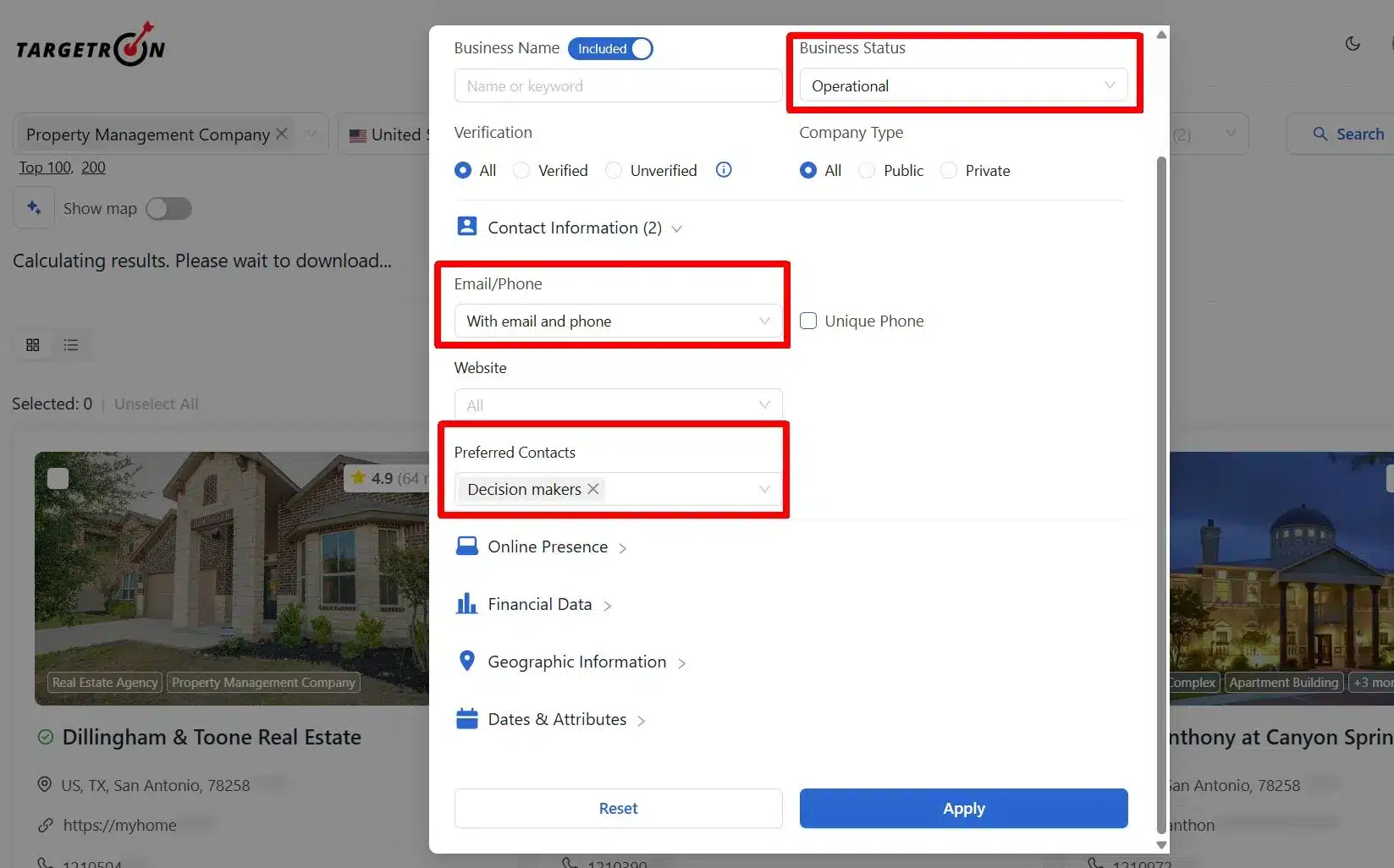
Targetron’s Advanced Filters options
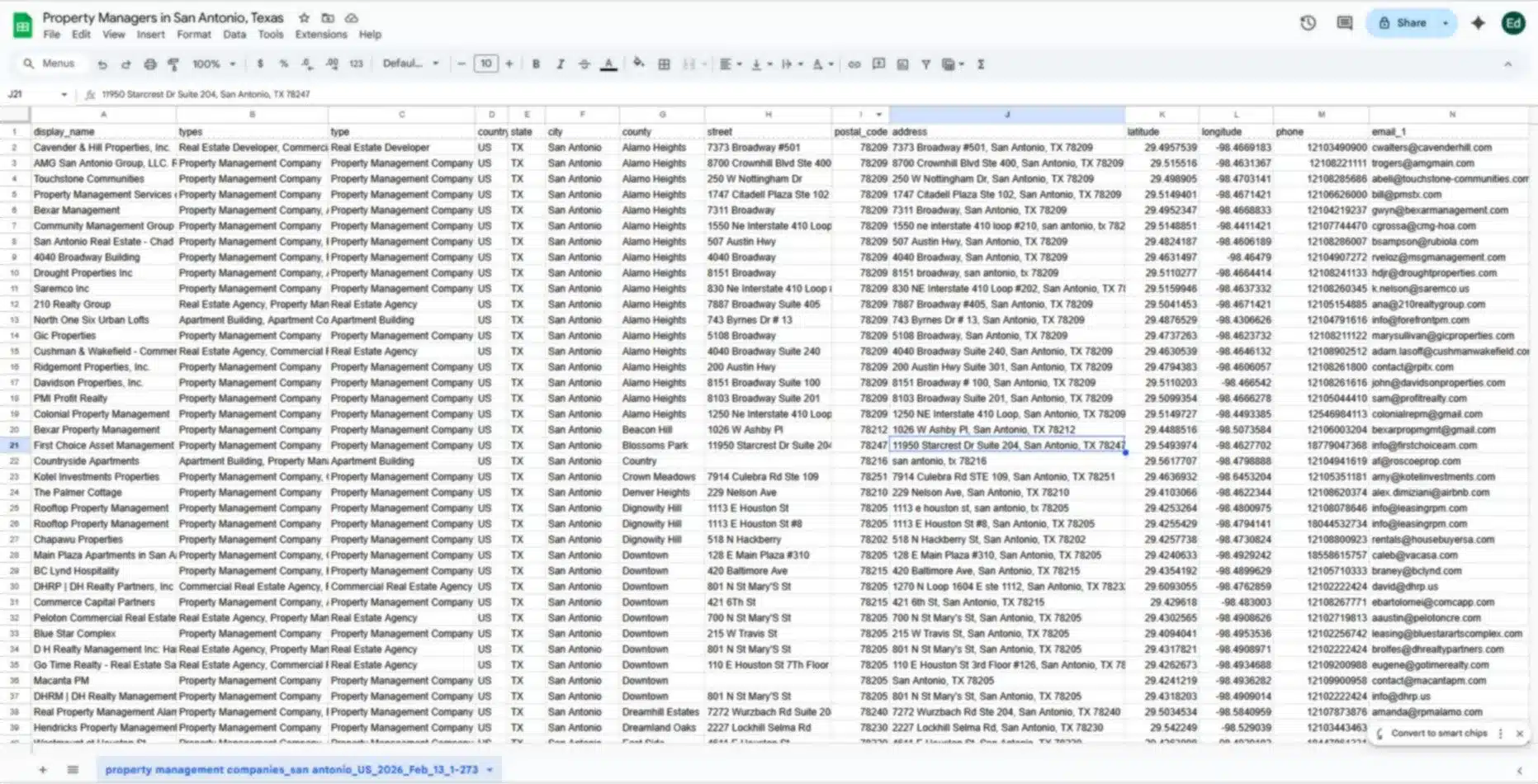
Sample data of Property Managers in Texas
When you refresh your Targetron lists regularly, you can treat your database as a living asset instead of a static spreadsheet. Over time, you can track which geographies, owner types, and business categories convert best and shift more of your budget and effort towards those segments.
If you are ready to move beyond shared online leads and third-party platforms, start by building your own real estate owner database with Targetron.
Create an account, pull a focused list in your target market, and plut it into the follow-up system you already use. This turns the ideas in this guide into a concrete sales cycle you can measure and scale.
Most frequent questions and answers
A real estate lead is a person who has shown interest in buying, selling, or investing in property, either by submitting an inquiry or being identified through ownership data.
A real estate lead typically shows active intent (such as filling out a form), while a real property owner list is ownership-based data that allows you to initiate contact directly.
Yes, if you respond quickly, track performance in a CRM, and measure cost per closing rather than just cost per lead.
You should respond within minutes, because faster response times significantly increase contact and appointment rates.
You can use county tax records, property appraiser databases, FSBO and expired listings, or structured real estate owner databases that organize ownership-level data.
At minimum, track contact details, property type, estimated value, lead source, and qualification notes like timeline and motivation.
The biggest mistake is poor process management, such as slow response, inconsistent follow-up, and failing to measure cost per closing.