Arrange a Free Consultation.
Get Free Expert Advice
Don't wait for a call. Chat with our 5-decade experienced marketer via WhatsApp now!
Most sales representatives spend only part of their day actively selling.The rest can be consumed by research tasks, such as finding businesses without websites. This slows growth before outreach even begins. It kills growth even before you send an email. The choice between b2b lead generation vs. manual prospecting comes down to this speed trap. If you need to reach 100 prospects, you cannot spend 20 minutes on each profile without missing your targets.
Manual work feels productive, but it often stops you from selling. Instead of manually searching for one person at a time, using a lead generation database lets you find a verified list in seconds.
This business leads database moves your focus from hunting for data to having real conversations.
Since the average cold email response rate sits at just 5.1%, success requires a high volume of quality touches that manual prospecting simply cannot support. This system is faster and provides data that drives growth without the wait.
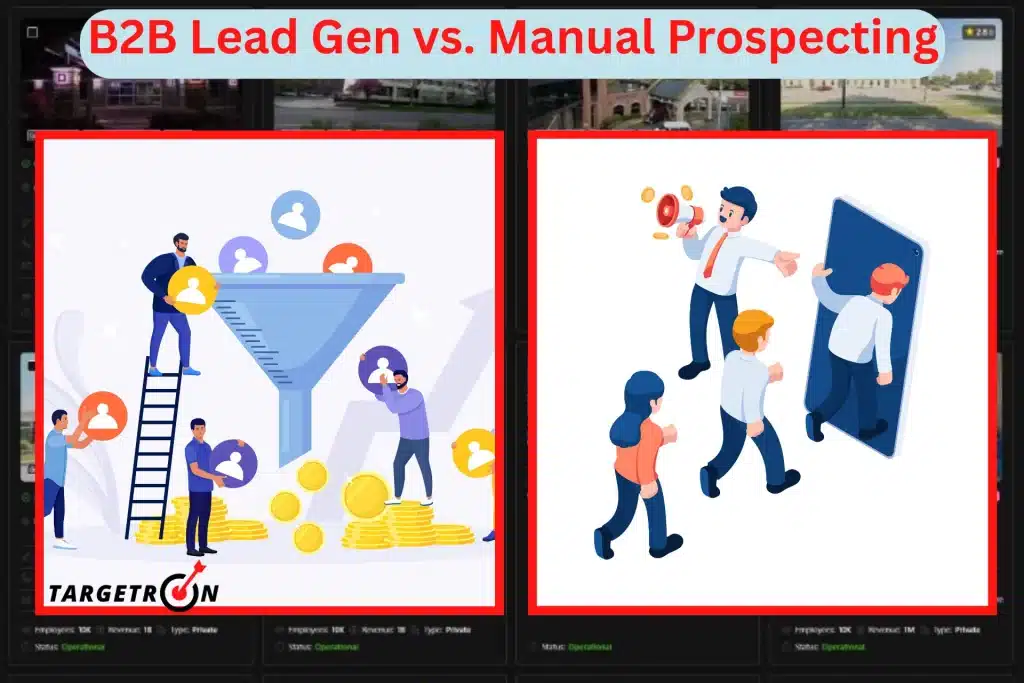
You should switch from manual effort to a lead generation database when your sales team spends more time on spreadsheets than on the phone. A sales lead database is a tool that removes the search phase from your day. This is specially useful for high-intent tasks like finding newly registered businesses to reach founders before your competitors do. When you know exactly who you need to reach, manual searching can slow down your growth.
In our experience, a B2B SaaS company targeting dental clinics in Florida saved two weeks of research time. By using Targetron’s B2B leads database, they pulled a verified list of 500 office managers with direct emails in five minutes. This shifted the team’s energy from “finding” to “closing.”
This transition is necessary once your ideal customer profile is clear. If you already know the job titles and industries you want, paying a rep to find them one by one is a waste of resources. A sales leads database provides instant, filtered access to direct dials and verified emails.
This allows your team to skip the manual grind and start reaching out to potential customers. It turns lead generation into a predictable system rather than a daily struggle for finding contacts.
Most businesses view the monthly subscription or pay-as-you-go cost of a sales lead database as an expense. What they often overlook is the far greater cost of paying employees to spend hours on tasks that automation can complete in seconds.
When a Sales Development Representative (SDR) spends four hours a day searching for contacts, you aren’t just paying for their time. You are losing the revenue they could have generated by talking to prospects.
The main difference lies in repeatability and volume. With a business leads database, you can export a targeted list for an entire industry in one click. Manual prospecting requires starting from scratch every morning, which slows you down and makes growth harder.
Below is a breakdown of how the two methods compare in a typical work week:
| Sales Activity (Weekly) | Manual Prospecting | Lead Generation Database |
|---|---|---|
| Research Time | 20 to 25 Hours | Under 1 Hour |
| Lead Volume | 100 to 150 Leads | 1,000+ Leads |
| Cost Basis | $600 to $800 (Labor) | ~$100 to $200 (Sub) |
| Data Hygiene | Varies by Rep | Verified & Standardized |
We analyzed a recruiting agency in Oakland, California, that spent five hours every morning on job boards. By switching to a sales leads database, they moved that research time to under fifteen minutes. This allowed the team to increase their daily outreach by 400% without adding to their payroll.
Also, the indirect cost of “context switching” is high. Moving between networking sites, Google, and a CRM is a detailed process that drains energy. A database keeps the workflow clean. You use the tool to get the data, then you spend the rest of your day in meetings. This key shift ensures your highest-paid employees are doing the work that grows the business.
While a lead generation database handles your volume, manual prospecting is for Tier-1 accounts. If a single deal could define your entire quarter, you cannot rely only on automated lists. Account-Based Marketing (ABM) requires a level of human-verified accuracy that even the best business leads database may lack. When the deal size is big, every detail matters.
Manual work wins when you need to understand the internal politics of a company. A sales lead database tells you who the CEO is. It won’t tell you they just gave a keynote at a San Francisco SaaS summit about a specific pain point your product solves. That ‘last-mile’ detail is what turns a cold pitch into a partnership.
Also, manual work allows you to find small, personal hooks that turn a cold email into a warm conversation. If your target is a Fortune 500 executive, they receive hundreds of automated emails daily. To stand out, you must do the careful research that a machine cannot replicate.
This does not mean you stop using your sales leads database. Instead, you use it to identify the right accounts and then switch to a manual approach for the top 5%.
We’ve seen agencies in Oakland, California, use a business leads database to flag startups that just closed a Series B round. They then switch to manual research to find the specific challenges mentioned in the founder’s recent press release. This blend ensures you aren’t just hitting numbers. You are building relationships with high-value targets.
The most effective sales teams do not choose one method over the other. They combine a lead generation database with targeted manual effort to create a high-volume, high-quality system.
This hybrid model allows you to scale your outreach while keeping the “human” element that closes deals. It is not just a choice between speed and quality. It is about using the right tool for the right stage of the funnel.
The 5-Step Hybrid Workflow
The Seattle Case Study
A software firm in Seattle used a sales leads database to find 1,000 IT managers. They ran automated emails for 950 of them to get 15 meetings a month. This gave their senior reps the time to focus on 50 big targets. Those 50 targets eventually brought in $500k in new business because the reps weren’t too tired from manual research to write a good pitch.
Most frequent questions and answers
Manual prospecting is only worth the time for your top 5% of targets. These are the high-stakes accounts where a personalized hook can define your quarter. For the other 95% of your list, you should use a lead generation database to maintain the volume required to hit your sales targets.
A database removes the research chokepoint. Instead of spending 20 minutes finding one contact, you can export a verified list of hundreds of prospects in seconds. This allows your team to move away from spreadsheets and spend their energy on having real conversations with potential customers.
No, as long as you use a business leads database that provides verified emails and direct dials. Sending emails to unverified addresses is what hurts your sender reputation. A high-quality tool ensures your data is clean so your messages actually reach the inbox.
Yes. You can use the “Hybrid Workflow” to stay personal. Use the database to batch your mid-tier prospects for automated outreach, then use the “5-Minute Hook” rule for your high-value targets. This ensures you stay human without slowing down your growth.
Most teams save hours of manual labor every morning. For example, we analyzed a recruiting agency that moved from five hours of daily research to under fifteen minutes by using a sales leads database. This allowed them to increase their outreach by 400% without hiring more staff.
