Arrange a Free Consultation.
Get Free Expert Advice
Don't wait for a call. Chat with our 5-decade experienced marketer via WhatsApp now!
Selling to doctors and hospital administrators is notoriously difficult nowadays. According to the Healthcare Sales Association’s benchmark study, the average sales cycle has stretched to 14.7 months.
Recent Forrester research also reveals that a typical buying committee now involves 13 internal stakeholders and 9 external influencers, bringing a total to 22 decision-makers for complex purchases. Most outreach efforts are ignored because they lack a clinical context.
Healthcare Lead Generation 2026: From “Cold Calling” to “Permission-Based Sales”
Traditional cold calling is no longer effective. Healthcare sales outreach requires a direct, data-informed approach that focuses on relevance, timing, and each provider’s specific needs. Medical sales leads require a direct, data-backed approach. Success in 2026 isn’t about the volume of emails you send. It is about being relevant when a provider actually has a problem to solve.
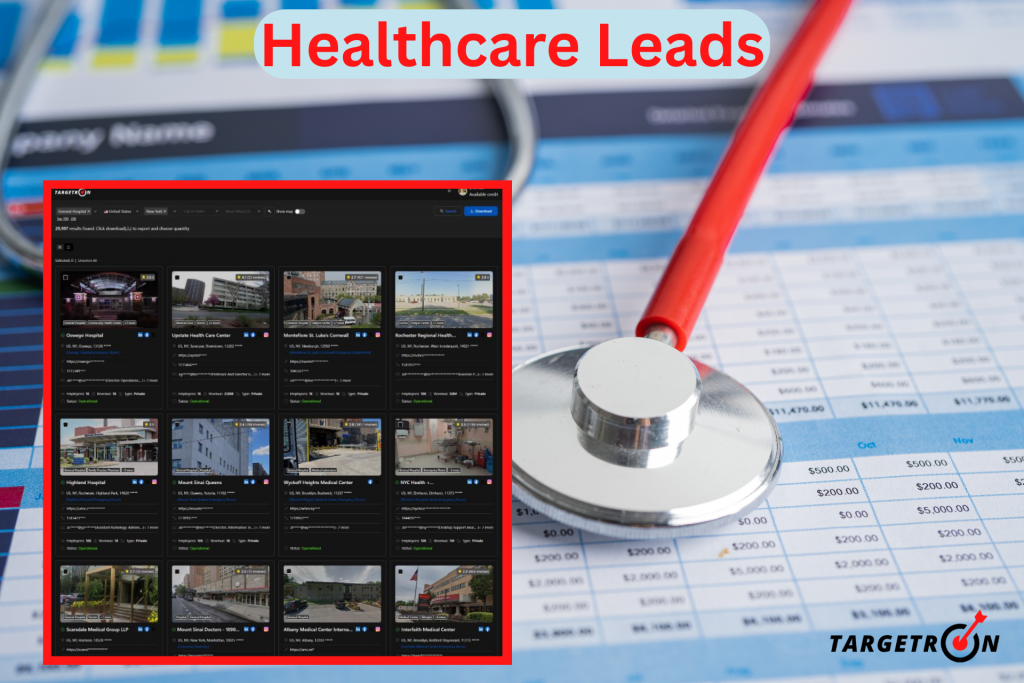
You can start finding new customers with Targetron by identifying high-value targets who match your ideal customer profile.
Snov.io reported that B2B cold outreach response rates for healthcare are hovering around 5.1%. With this data, you need to know exactly who the decision-makers are and what specific challenges they face before you hit send.
As a marketer or a lead generation specialist, you should use precise data to identify high-value targets. This will help you manage the challenges of long sales cycles and ensure you reach out with the right message at the right time.
Most marketing fails because it treats a hospital like a retail customer. Effective B2B healthcare lead generation isn’t about patients. It is about reaching the Clinical Directors, CEOs, and IT Heads who oversee the budget. These stakeholders make decisions based on long-term plans and strict risk assessments.
Staying Relevant After the First Six Months
The average healthcare sales cycle now lasts 14.7 months. Trust is built over multiple touchpoints, not one whitepaper. You must manage the challenges of this long timeline by providing consistent value for over a year. If you lose focus in month six, a competitor will step in.
What Clinical Directors Actually Look for Before Replying
In the medical world, social proof is your most powerful tool. Clinical Directors will not risk their reputation on an unproven service. Case studies and HIPAA compliance are the only ways to start a real conversation.
High-level decision-makers prioritize data security and peer validation above all else. Also, the importance of your service often depends on how well it fits into their existing workflow.
Most outreach fails because the data is stale or outdated. If you buy a static list, you are likely emailing people who left their jobs months ago. To build a predictable pipeline, you need a dynamic B2B leads directory that provides verified and real-time data.
Targetron allows you to move past the “bought list” trap. Instead of relying on a spreadsheet from last year, you can follow a B2B sales leads database guide to find active healthcare providers. This ensures your bounce rate stays low and your sender reputation remains high.
Healthcare is not a “one size fits all” industry. A small pediatric clinic in Amador City, California, has different needs than a large surgical center in Los Angeles. If you send the same generic pitch, you will lose both prospects. Targetron allows you to find local business leads by filtering for medical specialty, facility size, or geographic location.
By using these filters, you can tailor your message to the specific scale of the prospect. A small clinic owner cares about administrative ease. A hospital CEO is concerned with system-wide efficiency and reducing long-term costs. Precision filtering allows you to speak both languages.
The biggest hurdle in healthcare lead generation is the “info@” or “admin@” email address. These are called gatekeepers’ inboxes, where most emails are ignored. A B2B leads directory helps you find direct contact info for the people who actually sign the checks.
Reaching a Clinical Director or a Head of IT directly is the only way to shorten that 14.7-month sales cycle. When you bypass the general inbox, your message actually gets read. This direct access is how you turn a cold prospect into a warm lead.
In the medical world, you don’t earn a meeting until you prove you aren’t a liability. Data privacy isn’t just a legal checkbox. It is the first thing a Clinical Director looks for. If your outreach feels like it’s touching sensitive areas without permission, your email will be deleted before they even read your offer.
The key is showing that you understand the boundary between a doctor’s business life and their patient’s private lives. Understanding the difference between B2B sales data and patient data is how you stay compliant.
The Difference Between Professional Data vs. Patient Records
One of the biggest misunderstandings in healthcare lead generation is what “data” actually means. Platforms like Targetron provide business data such as professional emails and office locations.
Note that this is not patient data or Protected Health Information (PHI). You are reaching out to a provider as a business entity. You are looking for the person who manages the clinic, not the patient in the waiting room. Keeping these two worlds separate is how you stay compliant while building a sales pipeline.
Compliance is Mandatory for Growth
Using standard B2B tools is a legal risk if they accidentally touch PHI. In this industry, a single data leak can end a company. Only use verified B2B databases and lead generation services that understand healthcare privacy laws. A good next step is to audit your sources to ensure they do not store sensitive records.
The Reward: Leading with Security
Providers fear HIPAA violations more than almost anything else. If you lead your outreach by mentioning your security credentials, you remove that fear right away.
When a Clinical Director sees you prioritize data integrity, they are more likely to talk to you. This builds the trust needed for a 15-month sales cycle and proves you are a professional partner who respects their environment and their patients’ privacy.
Not all traffic is worth your time. In healthcare, top-of-funnel leads can stay in your system for years without buying. To build a pipeline that closes, focus on channels where the prospect shows active intent. You need to find the people who are already looking for a specific solution.
Focus on “Ready-to-Buy” Keywords
SEO for healthcare works best when you focus on “bottom of funnel” keywords. If a prospect is searching for “medical sales lead generation pricing” or “best healthcare CRM,” they are ready to talk. A good next step is to create content that directly compares your services to competitors. This helps the 22 decision-makers on the buying committee validate their choice quickly.
Professional Networking Site Outreach: The Soft-Touch Approach
The leading professional networking platform is a powerful tool for reaching Clinical Directors, but most people use it incorrectly. Do not start with a pitch. Instead, use a soft-touch approach.
Share a specific result you achieved for a similar clinic or hospital. For example, mention how you helped a surgical center reduce patient no-shows by 20%. This establishes authority without being pushy.
Data Integration: Preventing Lead Decay
A lead generation plan only works if it is consistent. If your data sits in a spreadsheet for two weeks, it is already losing value. In an industry with a 15-month sales cycle, you must move your leads from Targetron into your CRM smoothly.
This prevents “lead decay,” where contact info goes stale or a prospect loses interest. When your data flows directly into your CRM, you can track every touchpoint over that long sales cycle without manual data entry.
Choosing the right partner is the difference between a high-growth pipeline and a wasted budget. In the medical world, the stakes are higher because of strict regulations and long sales cycles. You need a partner who understands that healthcare is not a “one size fits all” market.
What to Look For: Specialists vs. Generalists
Avoid generalist agencies. A firm that sells to both plumbers and plastic surgeons will not understand the nuances of a 15-month medical sales cycle. Look for a team that specializes in medical practice growth and uses modern sales intelligence tools. They must explain how they maintain medical accuracy in their copy and explore complex hospital buying committees.
Pricing Models: Aligning Incentives
Most healthcare lead generation experts use a hybrid pricing model. Expect a monthly retainer to cover tools and data, plus a performance fee for every qualified meeting booked.
In 2026, a qualified B2B meeting in healthcare costs between $300 and $900. This model ensures the agency delivers quality prospects rather than just raw contact info.
The Red Flag: The “Thousands of Leads” Trap
If an agency promises “thousands of leads” for a low flat price, walk away. These are usually low-quality, non-compliant lists. There are many reasons why B2B leads database fails to drive sales, and using these lists will hurt your sender reputation.
Real growth comes from highly targeted, verified outreach. A smaller list of 50 high-intent leads is worth more than 5,000 generic names that will never reply.
Most frequent questions and answers
The 14.7-month timeline is driven by the size of the buying committee. In 2026, a typical medical purchase involves 22 decision-makers, including Clinical Directors, IT security heads, and financial officers. Each stakeholder has a different priority, and building consensus across these departments takes time.
Yes, as long as you are using professional business data and not patient records. Using a tool like Targetron to find a doctor’s office email is compliant because it is public business information. HIPAA rules only apply when you handle Protected Health Information (PHI) like patient names or medical histories.
The best way to bypass the general inbox is to use sales intelligence to find direct lines and professional emails for specific roles. Reaching a Clinical Director directly is the only way to avoid the digital black hole of the admin folder. If you must send to a general address, ensure your subject line mentions a specific peer-level result to catch their eye.
High bounce rates usually happen because of “data decay.” Healthcare staff move between clinics and hospitals frequently. If you are using a static list from six months ago, many of those people have likely moved on. Using a real-time directory keeps your bounce rate low and protects your sender reputation.
In 2026, most experts use a hybrid model. This includes a monthly retainer to cover the cost of data and tools, plus a performance fee for every qualified meeting booked. Expect to pay between $300 and $900 per meeting, depending on how high up the decision-maker is in the hospital hierarchy.
