Best Free B2B Lead Generation: 15 Methods for 2026
Table of Contents
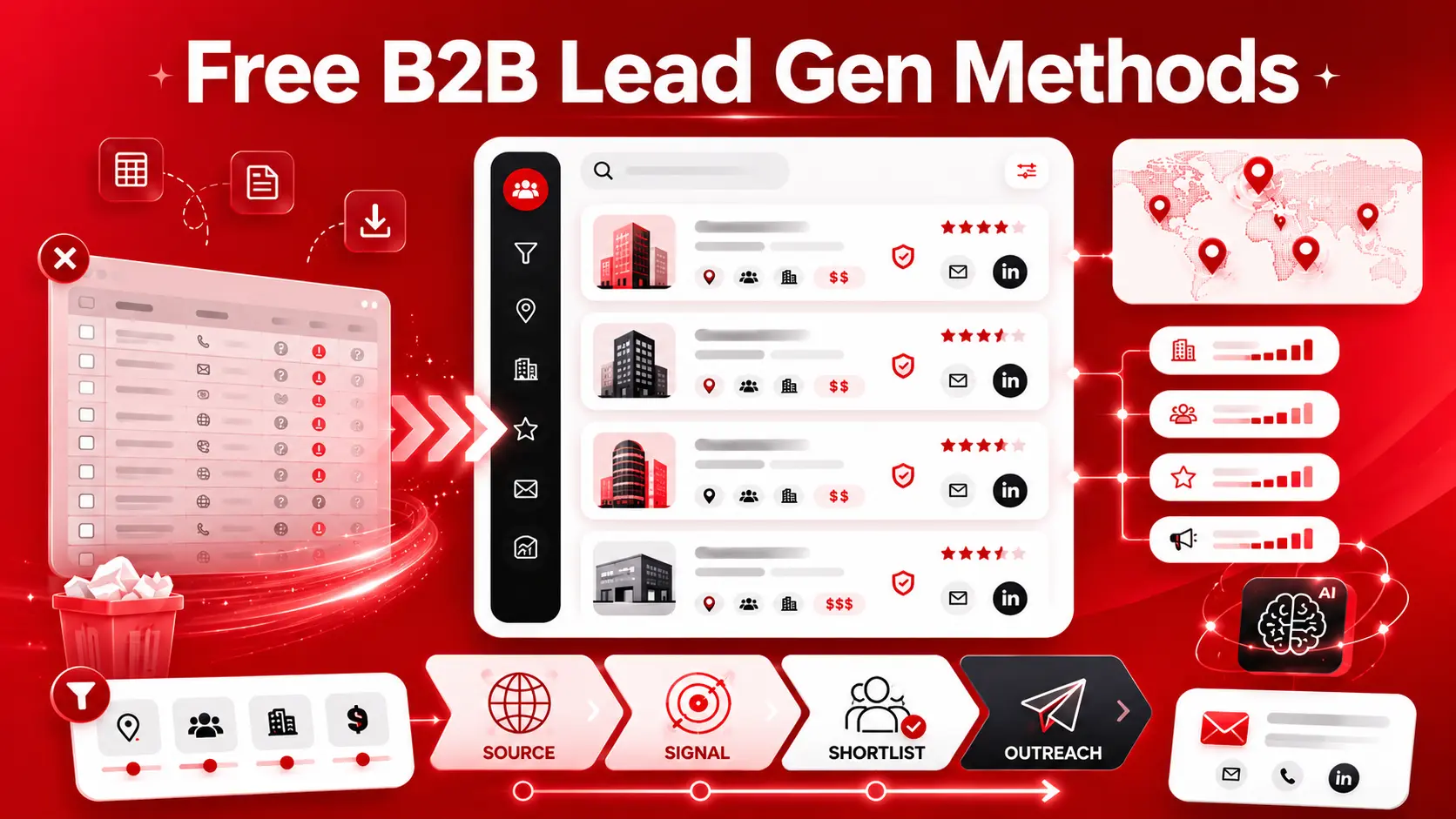
Quick answer:
The best free B2B lead generation methods are:
- LinkedIn research
- Referrals
- SEO content
- Niche communities
- Job board prospecting
- Review site research
- Cold email research
- Partnerships
- AI-assisted research
- Public business data research
These methods work best when you choose one target customer, look for clear business signals, shortlist only qualified prospects, and follow up with a relevant message.
What Is Free B2B Lead Generation?
Free B2B lead generation is the process of finding potential business customers without paying for ads, bought lead lists, or expensive prospecting tools. It includes methods such as LinkedIn research, referrals, content marketing, online communities, job board research, review site research, cold email research, and public business data research.
The goal is not to collect as many company names as possible. The goal is to find businesses that match your ideal customer profile, show a clear reason for outreach, and have contact information your team can use.
Free methods can reduce cash costs, but they still require time. You still need to research companies, check fit, clean your list, find the right contact, and write a relevant message. This becomes harder when you need to check categories, locations, websites, reviews, ratings, phone numbers, emails, and other business signals manually.
This approach works best for startups, consultants, agencies, freelancers, solo marketers, and small sales teams that are still testing their target market, offer, or outreach message.
A free lead is worth contacting when it meets four conditions:
- The company matches your target customer.
- There is a clear business signal related to your offer.
- The contact information is accurate enough to use.
- Your message can connect to a real reason for outreach.
A smaller list of qualified prospects is usually better than a large spreadsheet filled with poor-fit companies.
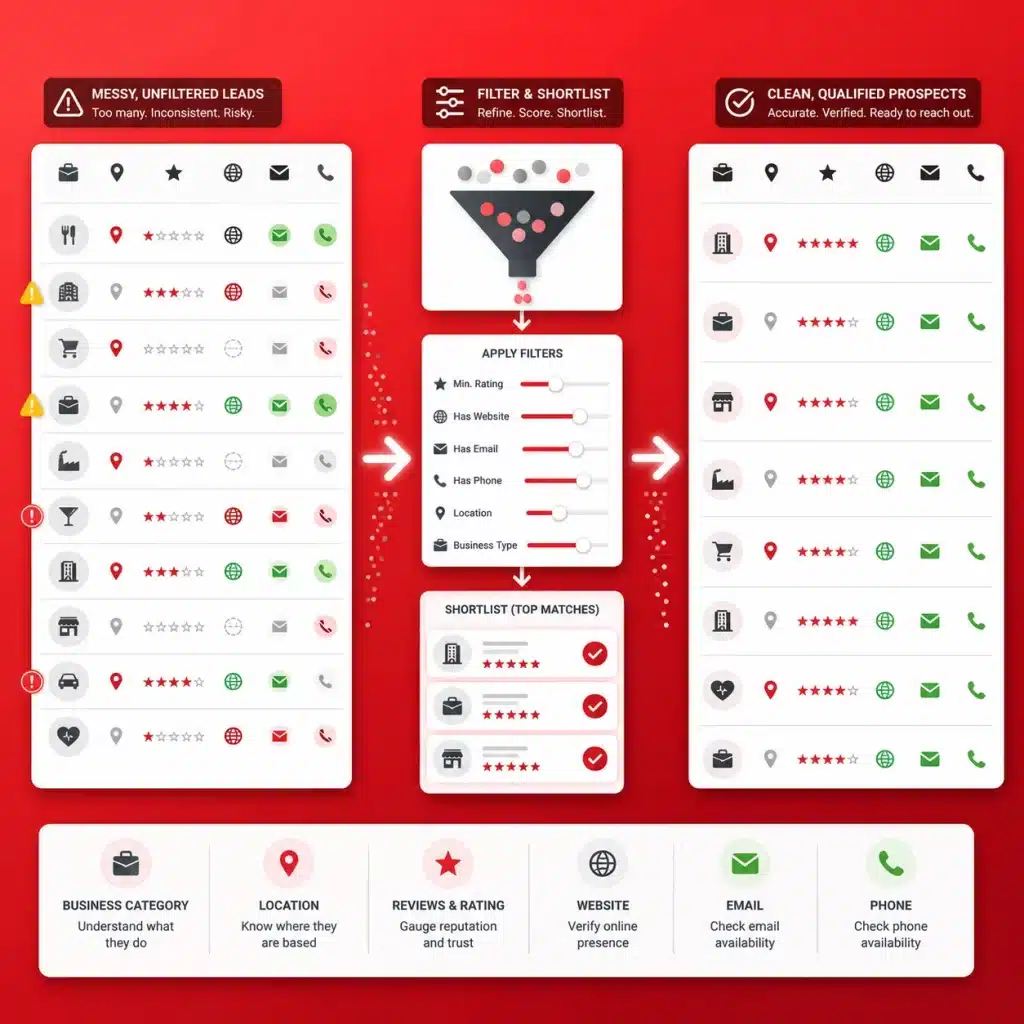
Free methods can help you find possible leads, but the list still needs to be checked, filtered, and cleaned. Use Targetron to find businesses by category, location, reviews, ratings, website presence, and other public signals before you start outreach.
Best Free B2B Lead Generation Methods Compared
The best free B2B lead generation method depends on your target customer, available time, and how quickly you need results. Some methods, such as referrals and job board research, can create faster conversations. Others, such as SEO content and community participation, take longer but can build trust over time.
This is also where the difference between B2B lead generation vs manual prospecting becomes important. Free methods can help you test different sources, but manual research can slow your team down when you need to check every company, signal, and contact detail one by one.
Use this table to compare each method before choosing where to start.
| Method | Cost | Effort | Speed | Best Use Case |
|---|---|---|---|---|
| LinkedIn Search | Free | Medium | Medium | Finding decision-makers by role, industry, location, or company type. |
| LinkedIn Commenting | Free | Medium | Slow-Medium | Building trust before sending a connection request or sales message. |
| Referrals | Free | Low-Medium | Fast | Getting warm introductions from clients, partners, peers, or past contacts. |
| SEO Content | Free | High | Slow | Attracting long-term inbound leads from search queries and buying-stage topics. |
| Niche Communities | Free | Medium | Medium | Learning pain points and joining relevant conversations in Slack, Discord, or industry groups. |
| Reddit and Quora | Free | Medium | Slow | Answering long-tail questions and finding ideas for future lead-focused content. |
| Cold Email Research | Free-Low | High | Medium | Contacting prospects directly after finding a clear reason for outreach. |
| Job Board Prospecting | Free | Medium | Fast | Finding companies that are hiring, growing, or adding sales and marketing roles. |
| Review Site Research | Free | Medium | Fast | Finding businesses with visible pain points, repeated complaints, or service gaps. |
| Partnerships | Free | Medium | Medium | Reaching shared audiences through non-competing businesses or referral partners. |
| AI-Assisted Research | Free-Low | Medium | Fast | Grouping leads, summarizing notes, drafting outreach ideas, and checking message angles. |
| Public Business Data Research | Free-Manual | High | Medium | Finding local or niche businesses by category, location, reviews, ratings, and website presence. |
15 Free B2B Lead Generation Methods for Small Teams
The best no-cost lead sources are the ones your team can repeat every week. You do not need to use all of them at once. Start with the methods that match your audience, your available time, and the type of buying signal you can find.
1. Use LinkedIn search to find decision-makers
LinkedIn is one of the easiest free places to start because you can search by job title, company, industry, location, and recent activity. Look for people who match your buyer profile, then check their posts, company page, and role before sending a connection request.
A good LinkedIn lead is not just someone with the right title. It is someone who works at the right type of company and has a reason to care about your offer.
2. Turn LinkedIn comments into warm leads
Commenting on relevant posts can help you show up before you send a message. Instead of writing generic comments, add a useful point, answer a question, or share a small example.
Track people who reply to your comments, view your profile, or engage with your posts. These are warmer prospects than people you contact with no prior interaction.
3. Ask for specific referrals
Referrals work best when your request is clear. Do not ask, “Do you know anyone who needs leads?” That is too broad.
Ask something more specific, such as:
“Do you know any small agencies, consultants, or local service businesses that are still building prospect lists manually?”
A specific referral request makes it easier for people to remember the right contact.
4. Publish bottom-of-funnel SEO content
SEO content can generate leads over time when it targets problems buyers already search for. Instead of writing only broad educational posts, create content around specific prospecting needs.
Examples include:
- How to find B2B leads without buying lists
- How to find local business leads by category
- How to find companies without websites
- How to find businesses with bad reviews
- How to build a prospect list for outreach
These topics attract readers who are already trying to solve a lead generation problem.
5. Repurpose one useful guide into several lead sources
One strong piece of content can become several lead generation assets. A blog post can turn into LinkedIn posts, short videos, email tips, community answers, and a downloadable checklist.
This helps small teams get more value from one idea instead of creating new content from scratch every time.
6. Join niche communities before pitching
Slack groups, Discord groups, Reddit communities, founder groups, and industry forums can help you find real pain points. The key is to listen first.
Look for repeated questions, complaints, and requests for recommendations. Answer when you can help, but avoid joining only to promote and sell your product or service.
7. Use Reddit and Quora for long-tail demand
Reddit and Quora are useful for finding questions people ask before they are ready to buy. Search for problems related to your offer, then answer with practical steps.
Do not turn every answer into a pitch. A helpful answer can bring profile visits, content ideas, and future conversations.
8. Use job boards to find companies with active needs
Job boards can show which companies are growing, hiring, or changing direction. A company hiring sales, marketing, operations, or customer success roles may also need better lead sources, cleaner data, or a stronger outreach process.
You can also compare hiring activity with finding newly registered businesses to spot companies that may be new, growing, or preparing to sell in a specific market.
Use the job post as your outreach signal. For example:
“I saw that your team is hiring for a sales role. Many companies at that stage are also reviewing how they find and qualify prospects. Is that a current priority for your team?”
9. Use review sites to find pain-based leads
Review sites can reveal business problems that are visible from the outside. Look for repeated complaints, low ratings, poor customer experience, missing services, or slow response times.
For example, an agency selling reputation management can find businesses with recent negative reviews. A consultant selling operations support can look for complaints about delays, missed calls, or poor service consistency.
For a more specific use case, cleaning companies can look for restaurants with negative hygiene reviews and use those review signals to find businesses that may need better cleaning support.
10. Use public business data for local prospecting
Public business data can help you find leads by category, location, rating, reviews, website presence, phone number, and business status.
For example, you can search for dentists in one city, restaurants with low ratings, cleaning companies without websites, or local businesses with public contact details.
This method works well for agencies, consultants, local service providers, and B2B teams that sell to specific business categories.
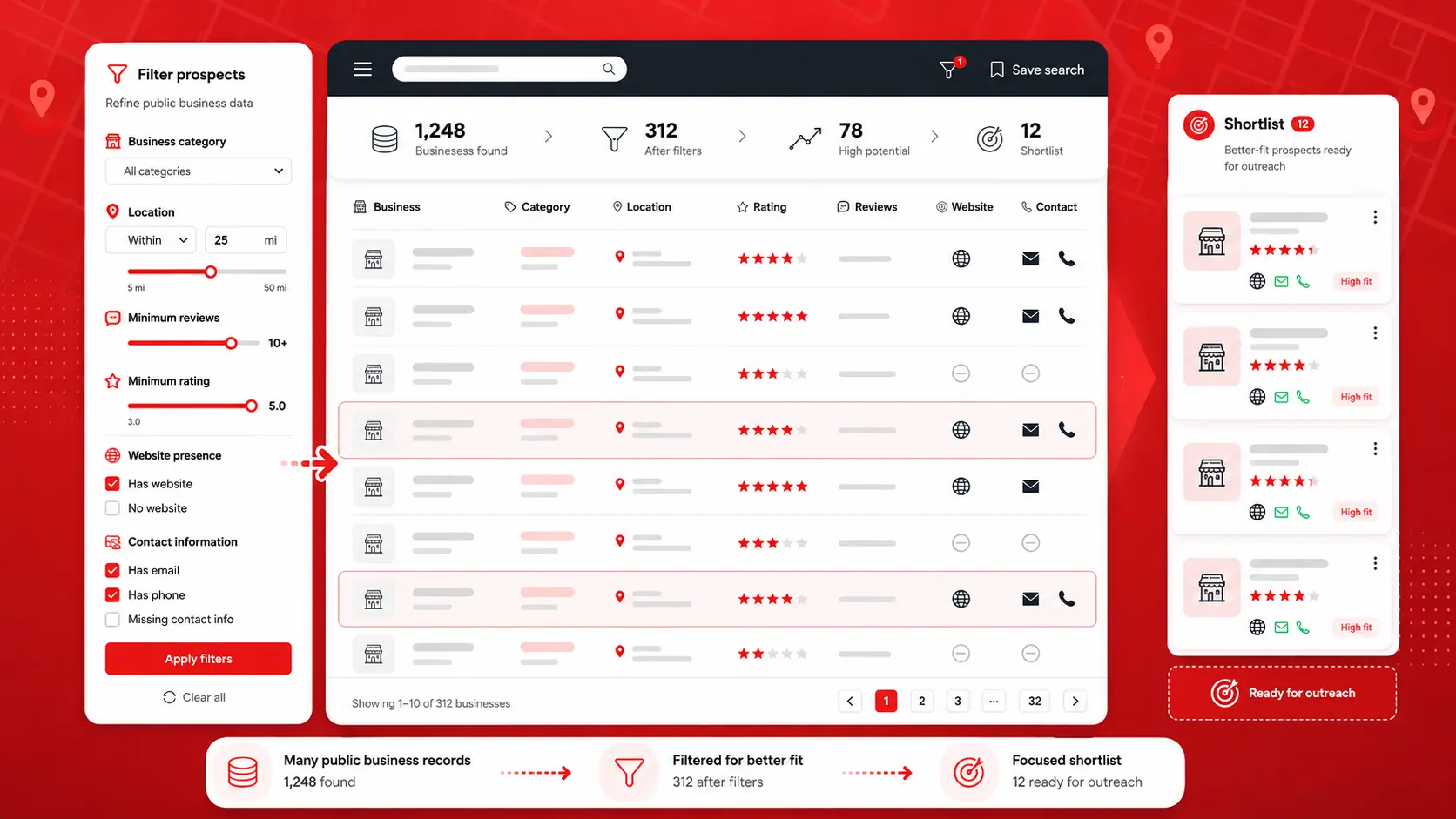
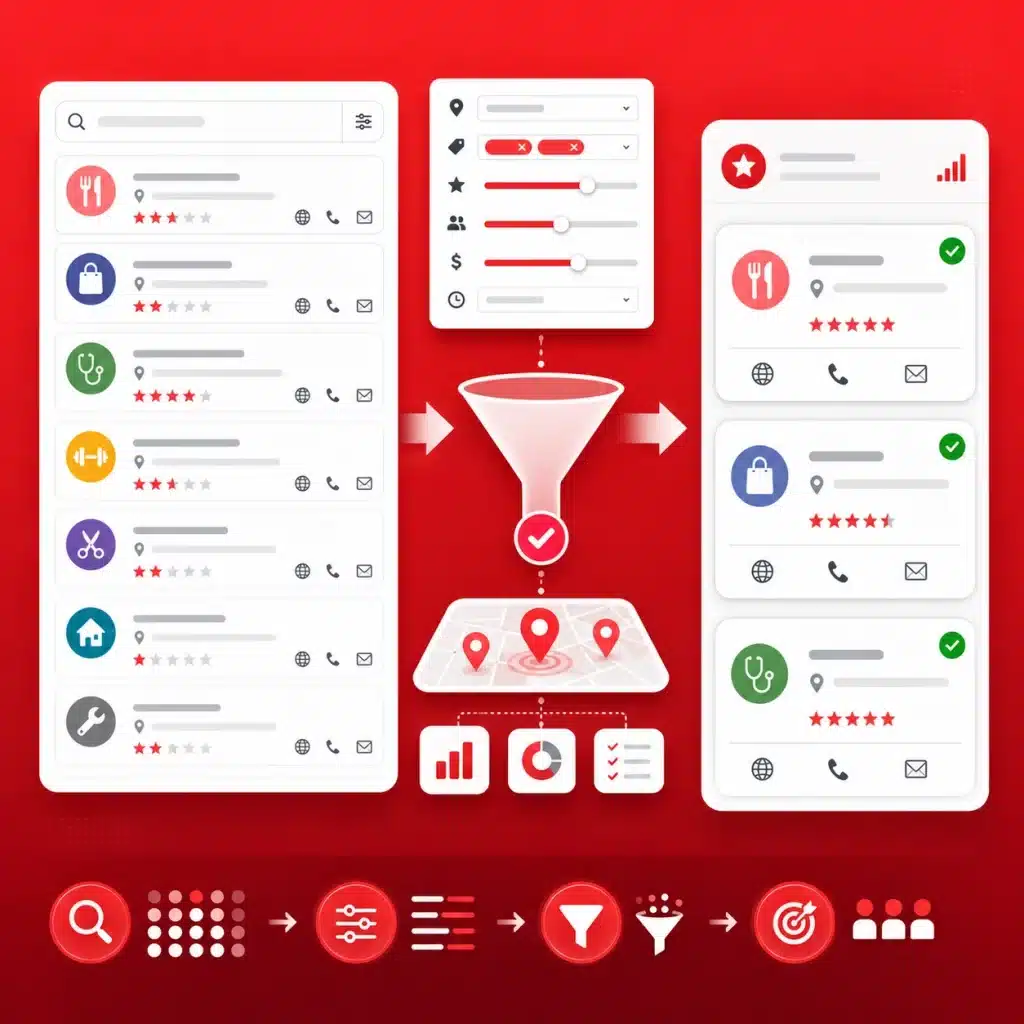
Manual research works, but it can take hours to check every business one by one. Targetron helps small teams search local businesses, review public signals, and shortlist prospects that better match their offer.
11. Build partner lists from non-competing businesses
Partnerships work when two companies serve the same audience but do not sell the same thing.
Examples:
- SEO agency and web design agency
- CRM consultant and sales trainer
- local marketing agency and reputation management provider
- bookkeeping service and business consultant
You can exchange referrals, co-create content, run a small webinar, or introduce each other to relevant clients.
12. Try guest posting for trusted audiences
Guest posting works best when you write for a site that already reaches your target buyers. Do not pitch broad topics. Offer a specific article that solves a real problem for their audience.
Example pitch idea:
“I can write a practical guide on how small B2B teams can build a prospect list without buying leads.”
The goal is to build trust, get relevant referral traffic, and show what you know to a new audience.
13. Run a free workshop or micro-webinar
A small workshop can create leads without a big budget. Choose one specific problem and invite a focused group of prospects.
Example topics:
- How to build your first B2B prospect list
- How to qualify local business leads before outreach
- How to find companies with visible buying signals
- How to improve outreach using better lead research
Keep the workshop useful. Then follow up with attendees based on the questions they asked.
14. Use AI to speed up research
AI can help organize lead research, group prospects by pain point, summarize notes, draft message ideas, and turn repeated questions into content topics.
But AI should not replace lead qualification. A person still needs to check whether the company matches the target customer, whether the signal is real, and whether the outreach message makes sense.
15. Use free lead generation tools carefully
Free tools can help you test your workflow before paying for software. Useful options include spreadsheets, free CRM plans, limited email finder credits, calendar tools, analytics tools, and AI tools.
The limit is that free tools often create fragmented workflows. Once your process starts working, you may need a better system for finding, filtering, exporting, and managing leads.
A Simple Free B2B Lead Generation Workflow
Free prospecting works better when you follow a repeatable process instead of jumping between random tactics. A simple workflow is:
Source → Signal → Shortlist → Outreach
This keeps your team focused on finding the right prospects, not just adding more names to a spreadsheet.
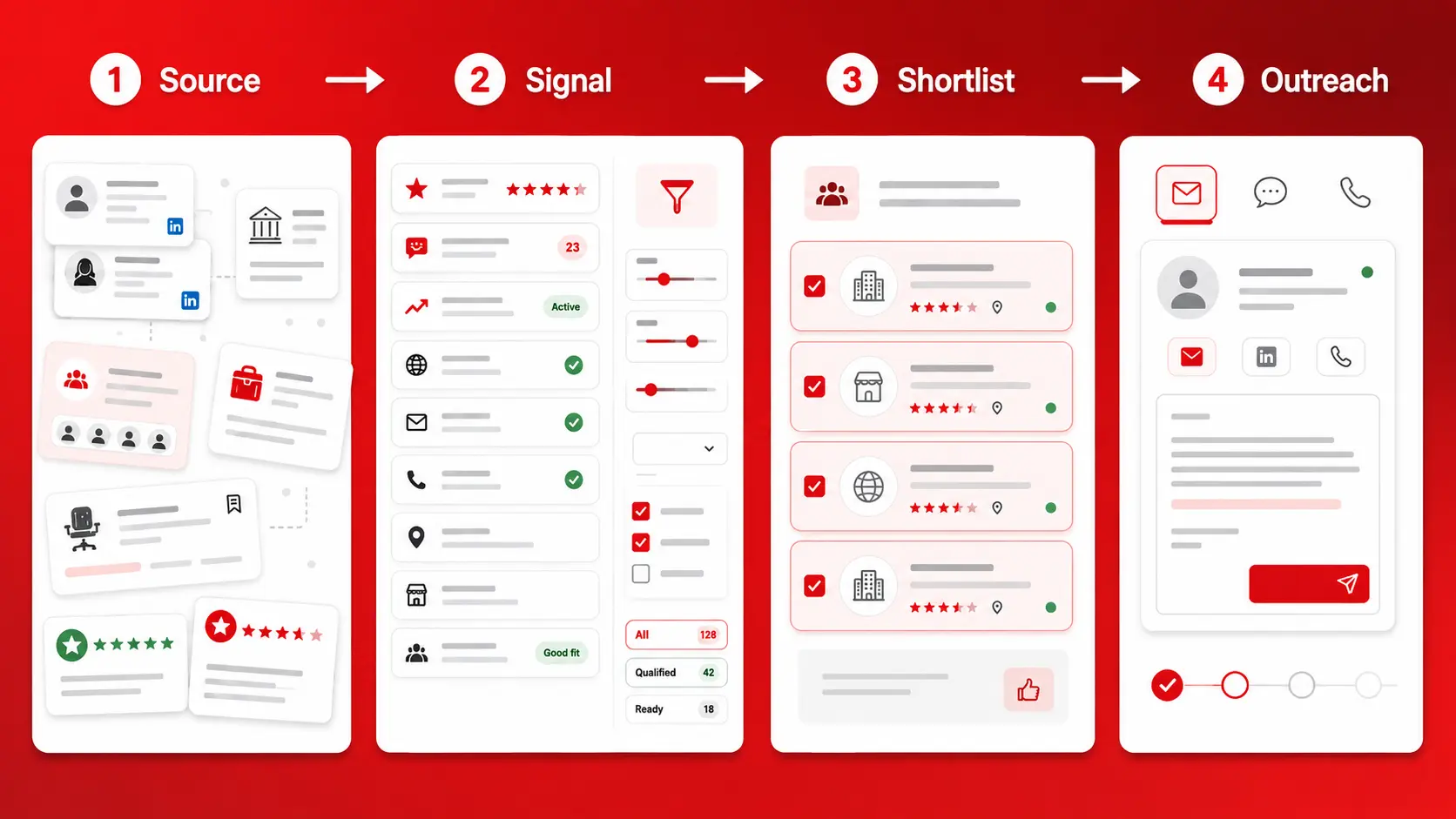
Step 1: Choose one lead source
Start with one source instead of trying every method at once. Choose based on where your target customers are easiest to find.
Examples:
- LinkedIn for decision-makers
- Referrals for warm introductions
- Job boards for companies that are hiring
- Review sites for visible customer complaints
- Communities for niche conversations
- Public business data for local or category-based prospecting
The goal is to build one focused list before adding more sources.
Step 2: Find a visible business signal
A business signal gives you a reason to contact the prospect. Without a signal, your message can feel generic.
Common signals include:
- hiring for sales or marketing roles
- recent negative reviews
- missing or outdated website
- new location opening
- low rating compared with competitors
- repeated customer complaints
- active LinkedIn posts about a related problem
- business category and location match
The stronger the signal, the easier it is to write a relevant message.
Step 3: Shortlist only best-fit prospects
Do not contact every company you find. Remove businesses that do not match your target customer, location, size, category, or offer.
A qualified prospect should answer four questions:
- Does this company match our ideal customer?
- Is there a clear signal connected to our offer?
- Can we find a usable contact method?
- Can we write a message that feels relevant?
A smaller qualified list is better than a large list that creates poor replies, bad data, and wasted follow-ups.
Step 4: Send outreach based on the signal
Your outreach should connect to the reason you selected the prospect. This makes the message more useful and less generic.
Example:
“Hi [Name], I noticed your team is hiring for a sales role. Many companies at that stage are also reviewing how they find and qualify prospects. Is improving lead research a current priority for your team?”
Another example:
“Hi [Name], I noticed several recent reviews mention slow response times. I work with teams that want to improve how they track and respond to customer inquiries. Is this something your team is trying to fix?”
The point is not to send a long pitch. The point is to show that your message is based on a real business signal.
30-Day Free B2B Lead Generation Plan
Building leads without paid tools becomes easier when you give yourself a clear plan. Instead of trying every method at once, use the first 30 days to define your target customer, build a focused list, qualify prospects, and test your outreach.
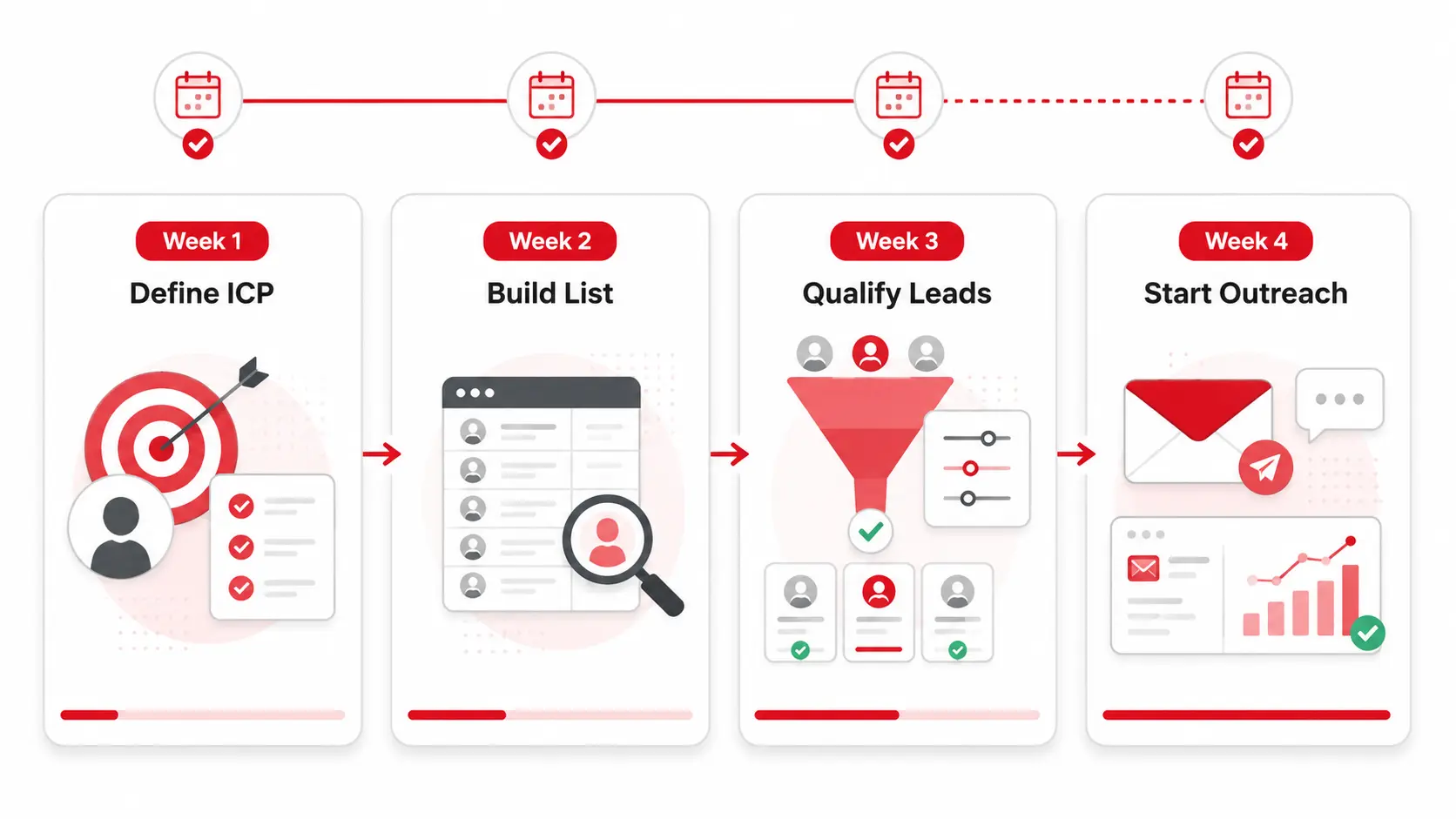
| Week | Goal | Tasks | Output |
|---|---|---|---|
| Week 1 | Define your target market | Choose your ideal customer, industry, location, buyer role, offer, and buying signal. | One focused prospecting segment |
| Week 2 | Build your first lead list | Use LinkedIn, referrals, job boards, review sites, communities, and public business data research. | 50 to 100 possible prospects |
| Week 3 | Qualify and clean the list | Remove poor-fit companies, check business signals, group prospects by pain point, and verify contact details where possible. | 25 to 50 stronger prospects |
| Week 4 | Start outreach and content | Send personalized messages, publish helpful posts, ask for referrals, and track replies. | First replies, meetings, and early learnings |
The goal is not to collect the largest list. The goal is to build a list that is accurate enough to use and focused enough to support relevant outreach.
Week 1: Define your target customer
Start by choosing one specific audience. A broad audience makes free lead generation harder because you do not know where to search or what signal to look for.
Define:
- industry or business category
- location
- company size
- buyer role
- main pain point
- clear reason they may need your offer
Example:
Instead of targeting “small businesses,” target “local service businesses in one city with weak websites, low review scores, or no clear lead capture process.”
Week 2: Build your first list
Choose two or three free sources. For example, you can combine LinkedIn search, job boards, and public business data research.
Add only basic information at first:
- company name
- website
- location
- business category
- contact person
- contact method
- visible signal
- notes
Do not spend too much time perfecting the list before you know whether the source can create replies.
Week 3: Qualify and clean your prospects
Review the list and remove poor-fit companies. This is where many free lead generation efforts improve.
Check:
- Does the company match your target customer?
- Is the business signal strong enough?
- Is the contact information usable?
- Can you write a message that connects to a real problem?
- Is this prospect worth your time?
Group prospects by pain point so your outreach does not sound the same for everyone.
Week 4: Start outreach and track results
Send personalized outreach in small batches. Start with 10 to 20 prospects so you can check reply quality before scaling.
Track:
- messages sent
- replies
- positive replies
- meetings booked
- bad-fit replies
- bounced emails
- follow-ups needed
Use the results to improve your next list. If one source produces better replies, focus there before adding more methods.
How to Measure Results and Know When Free Methods Are Not Enough
Free B2B lead generation only works if you measure both activity and lead quality. A large list does not mean much if most prospects are poor-fit, hard to contact, or unlikely to buy.
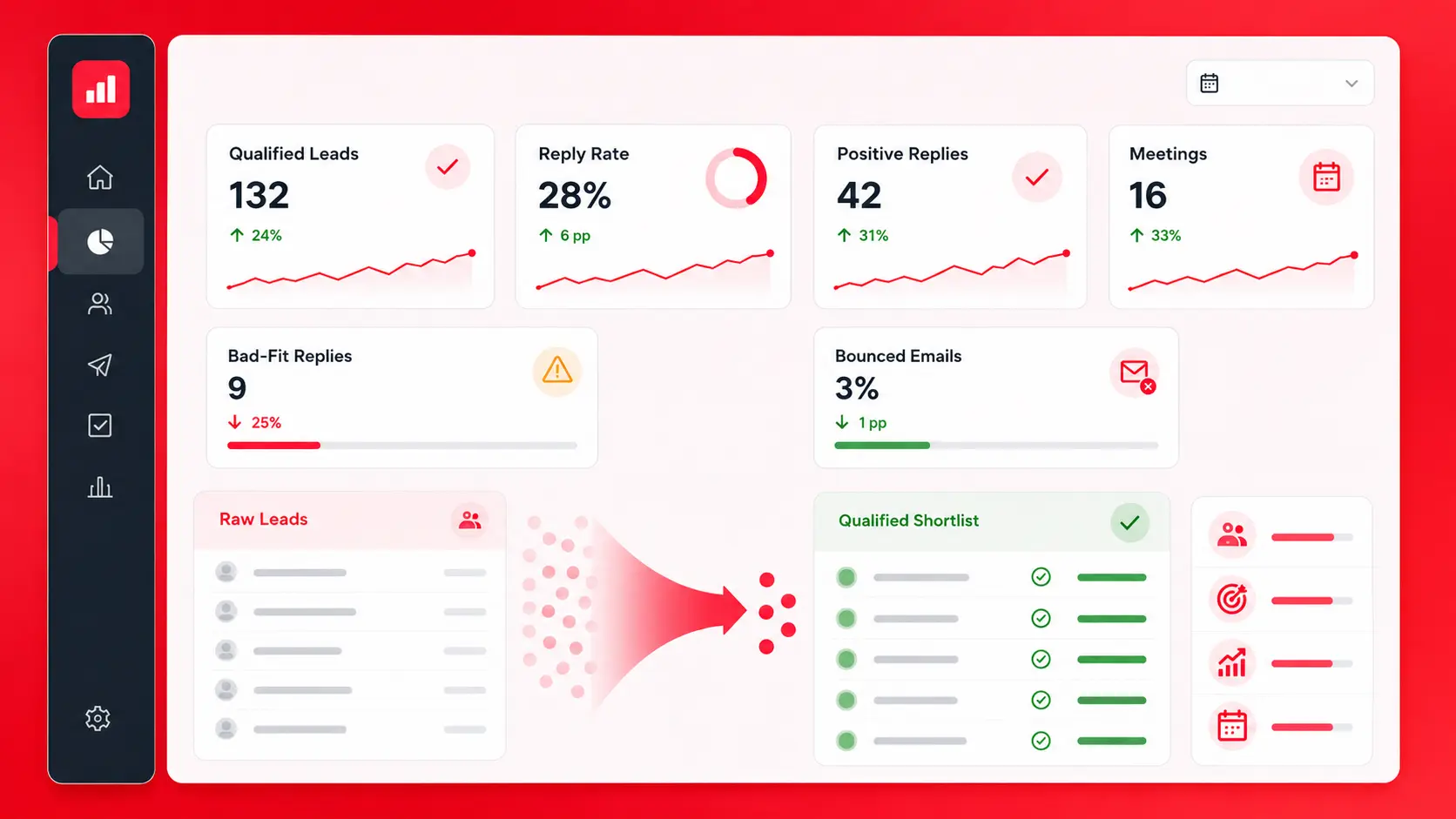
Start by tracking simple numbers:
- leads researched per hour
- qualified leads added
- messages sent
- reply rate
- positive reply rate
- meetings booked
- bounced emails
- bad-fit replies
- leads converted by source
The most important number is not always total leads. For small teams, a better metric is qualified leads per hour. This shows whether your free method is giving you usable prospects or just adding more manual work.
Once you start tracking replies, meetings, and source quality, you can also measure ROI in B2B lead generation to see which channels are worth repeating.
Signs your free lead generation process is slowing you down
Free methods are useful when you are testing your target customer, offer, and outreach message. But they can become difficult when the work starts taking more time than the selling.
Common signs include:
- You spend more time researching than contacting prospects.
- Your spreadsheet is hard to manage.
- You keep finding outdated or incomplete data.
- You cannot filter prospects quickly by category, location, reviews, rating, or website presence.
- You have too many poor-fit companies in your list.
- Your outreach messages sound generic because you do not have enough context.
- Your team cannot repeat the same process every week.
When this happens, the issue is not always the channel. The issue may be the research process behind the channel.
When to move to a more scalable prospecting system
Free lead generation is a good starting point when you are still learning your market. It helps you test which audience responds, which signals matter, and which messages create replies.
But once you know your target customer and the type of lead you want, manual research can slow growth. At that point, a tool-assisted workflow can help your team find, filter, and organize prospects faster.
If your team is ready to move beyond manual list building, a B2B sales leads database can help you search, filter, and organize prospects faster.
For example, instead of manually checking business categories, locations, reviews, ratings, websites, and contact details one by one, a platform like Targetron can help you build more focused prospect lists using public business signals before outreach.
This does not replace your plan. You still need a clear ICP, a relevant offer, and a good message. But it can reduce the time spent on manual research and help your team work from a cleaner, more targeted list.
Quick checklist before you scale free B2B lead generation
- Choose one target customer.
- Pick one or two lead sources.
- Look for clear business signals.
- Remove poor-fit prospects.
- Track replies, meetings, and qualified leads per hour.
- Move to a cleaner prospecting system when manual research slows your team down.
FAQ
Most frequent questions and answers
The best free B2B lead generation method depends on your target customer. LinkedIn works well for finding decision-makers, referrals work well for warm introductions, SEO content works well for long-term inbound leads, and job boards or review sites work well when you need visible business signals.
You can generate B2B leads without a budget by choosing one target customer, finding prospects from free sources, checking if they match your offer, and contacting only the companies with a clear reason for outreach. Start with LinkedIn, referrals, job boards, communities, review sites, and public business data research.
Free B2B lead generation does not require ad spend or paid lead lists, but it still costs time. You need to research companies, check fit, clean your list, find contact details, write relevant messages, and follow up.
A lead is worth contacting if the company matches your ideal customer profile, has a clear business signal related to your offer, has usable contact information, and gives you a real reason to send a relevant message.
Move from free lead generation to a paid or tool-assisted workflow when manual research becomes too slow, your spreadsheet becomes hard to manage, or you need to filter prospects by category, location, reviews, ratings, website presence, and other business signals faster.
Yes. AI can help organize prospect notes, group leads by pain point, summarize reviews, draft outreach ideas, and turn repeated questions into content topics. A person should still review the final list and messages before outreach.
