Arrange a Free Consultation.
Get Free Expert Advice
Chat with Paul via WhatsApp now! Get a chance to receive free leads instantly.
Finding businesses with good reviews but no website sounds simple until you try to do it across an entire city or business category. You may find hundreds of local companies, but checking ratings, review counts, website presence, business status, and contact details one by one quickly turns into hours of manual research.
For web designers, marketing agencies, SEO consultants, and sales teams, the problem is not finding more businesses. It is narrowing a large market into prospects that show several useful signals at the same time.
A business with strong customer reviews but no apparent website can be worth checking because the reviews suggest real customer activity while the missing website points to a possible gap in its online presence. That does not automatically make the company a good lead, though. The business may already have a website that is not connected to its listing, or it may not be a good fit for your service.
if you are starting with broader website-gap search, see how to find businesses without websites before adding review-based qualification.
This guide explains how to combine review quality, website presence, business activity, and other prospect checks to find businesses worth researching further before outreach.
Quick Answer: How to Find Businesses With Good Reviews But No Website
A business without a website is only one signal. It tells you there may be a gap in its online presence, but it does not tell you whether the business is active, established, or worth researching further.
Adding review data gives you more context. Ratings, review count, and recent review activity can help separate active businesses from records that may not be a good fit for outreach.
A business with a strong rating and a steady number of reviews has evidence of customer activity. Recent reviews can also help show that people are still using the business.
This makes review data useful when narrowing a broad list of businesses without websites. Instead of treating every no-website record the same, you can focus first on businesses that show signs of current customer demand.
A list based only on website presence can contain many different types of businesses. Some may be inactive, have very few customers, or already have a website that is missing from the listing.
Combining several signals creates a more focused research process:
No apparent website + good reviews + active business status = a business worth checking further.
The purpose is not to create the largest possible list. It is to spend less time reviewing businesses that do not match your prospecting criteria, which aligns with Targetron users who want to reduce slow manual lead research.
Good reviews and no apparent website do not mean a business is ready to buy web design, SEO, or another marketing service.
The owner may already have a website that is not connected to the business listing. They may also rely on social media, referrals, or other channels and have no current interest in building a website.
Treat these signals as a reason to **research the business further**, not as proof that it is ready for outreach.
A high star rating alone does not tell you enough about a business. A 4.9-star business with five reviews is very different from a 4.6-star business with more than 100 reviews.
For prospect research, it is better to look at rating, review count, and review recency together. For a broader look at rating-based prospect research, see how to find companies with positive ratings before combining reviews with website presence.
The right thresholds will also depend on the business category and local market.
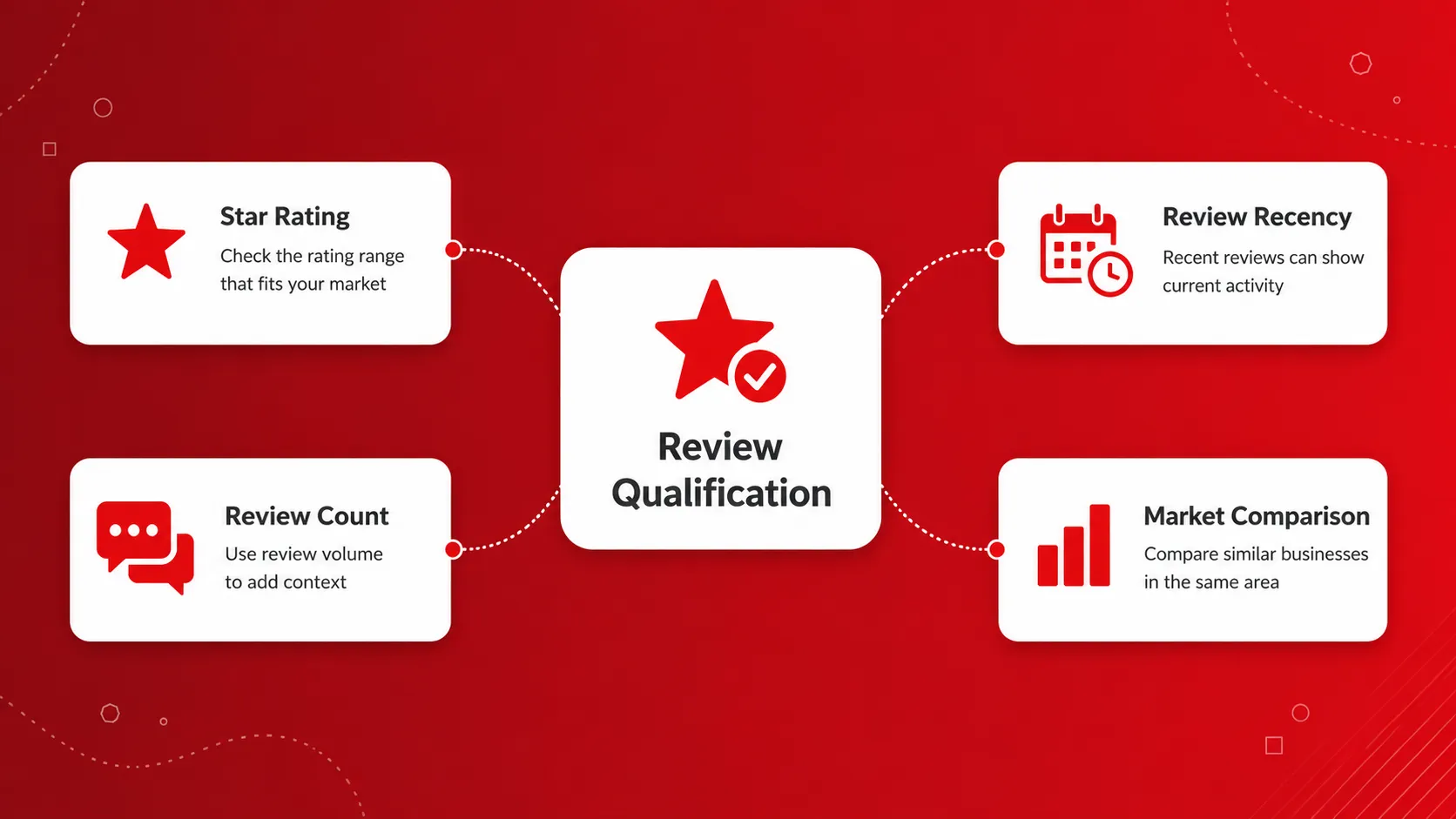
Start with a rating range that fits the type of businesses you are researching.
For example, you may choose to review businesses rated:
These are sample filters, not fixed rules. A useful rating threshold for restaurants may not make sense for plumbers, dentists, or accounting firms.
Review count helps add context to the star rating.
For example:
If your goal is to find established businesses, you may want to give more attention to companies with both a strong rating and a meaningful number of reviews.
Recent reviews can help show whether customers are still interacting with the business.
A company with strong ratings but no recent reviews may need more checking before you add it to your prospect list. Recent reviews, combined with an active business status, give you a better picture of current activity.
Review criteria should make sense for the market you are researching.
Instead of applying the same minimum review count everywhere, compare businesses within the same category and location. If most plumbers in one city have 20 to 40 reviews, a plumber with 100 reviews may stand out. In another city, 100 reviews may be common.
The purpose is to set criteria that help you narrow the market without removing businesses simply because they do not meet an arbitrary number.
Once you have defined what “good reviews” means for your target market, the next step is to combine those review signals with website presence and business status.
The aim is to reduce a broad market into a smaller group of businesses worth checking further. If you want to see the available search options in more detail, the Targetron advanced filters guide explains filters for website presence, ratings, reviews, phone availability, and other business fields.
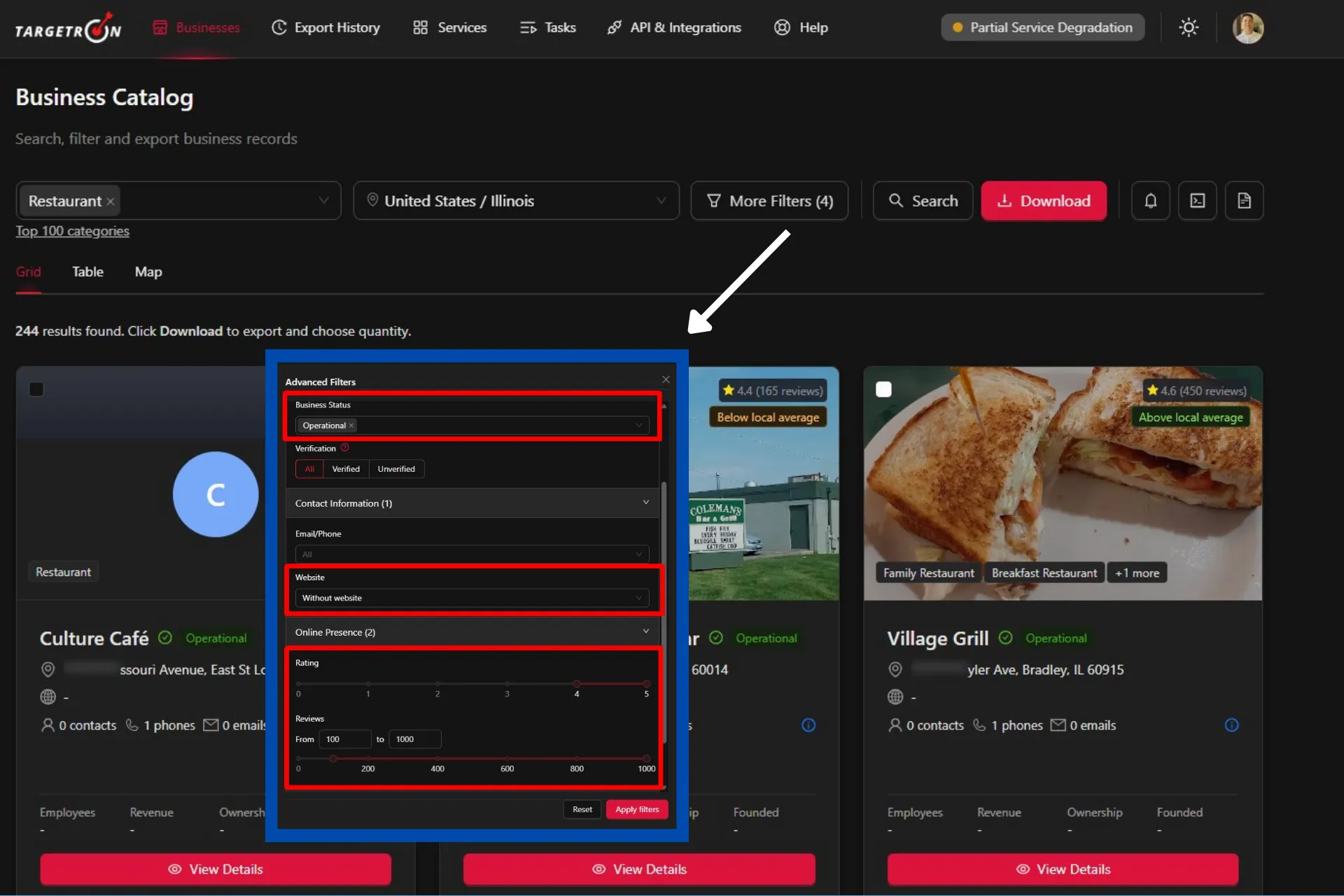
Use Targetron to narrow local businesses that match your target market, then review the records that show the right business, review, and website signals before spending time on outreach.
Start with a specific business type and geographic area. You can begin this research in Targetron’s B2B Local Leads Directory, where businesses can be searched by location, industry, and other criteria.
For example:
A narrower search makes it easier to compare businesses under similar market conditions and apply the same review criteria across the results.
Use the rating and review-count criteria you decided earlier to narrow the businesses you want to inspect.
Do not rely on rating alone. Review volume and recent customer activity can provide more context about whether a business is active and established.
Next, look for businesses where an official website is not apparent.
Treat this as another filtering signal rather than a final answer. A website may exist even if it is missing from the business record, so the website gap should still be confirmed before outreach.
Remove records that do not fit your operating-status requirements.
A business may have strong historical reviews but no longer be active. Checking status before spending more time on the record helps reduce unnecessary prospect research.
After combining the criteria, you are left with a more specific group:
Good reviews + no apparent website + active business status
Targetron can support this business-research workflow by helping users narrow local business records before reviewing which prospects are worth further checking. The final decision should still consider market fit, website verification, and contact readiness.
This approach helps reduce the time spent reviewing businesses that do not match the campaign from the start.
Watch the workflow below to see how review signals, website presence, and business status can be combined before deciding which records deserve further research.
See how rating, review count, website presence, and business status work together when narrowing local business prospects before outreach.
Contact verification works best when every record follows the same process. A fixed workflow helps sales teams decide which contacts are ready, which need more checking, and which should be removed before a campaign starts.
A simple comparison can help show why **good reviews plus no website** works better as a combined prospecting signal than either factor alone.
Consider four local businesses found during the same research process:
| Business | Rating | Reviews | Website | Status | Action |
|---|---|---|---|---|---|
| Business A | 4.7 | 126 | No website listed | Active | Review first |
| Business B | 4.9 | 4 | No website listed | Active | Check further |
| Business C | 4.6 | 95 | Website found | Active | Remove |
| Business D | 4.5 | 88 | No website listed | Closed | Remove |
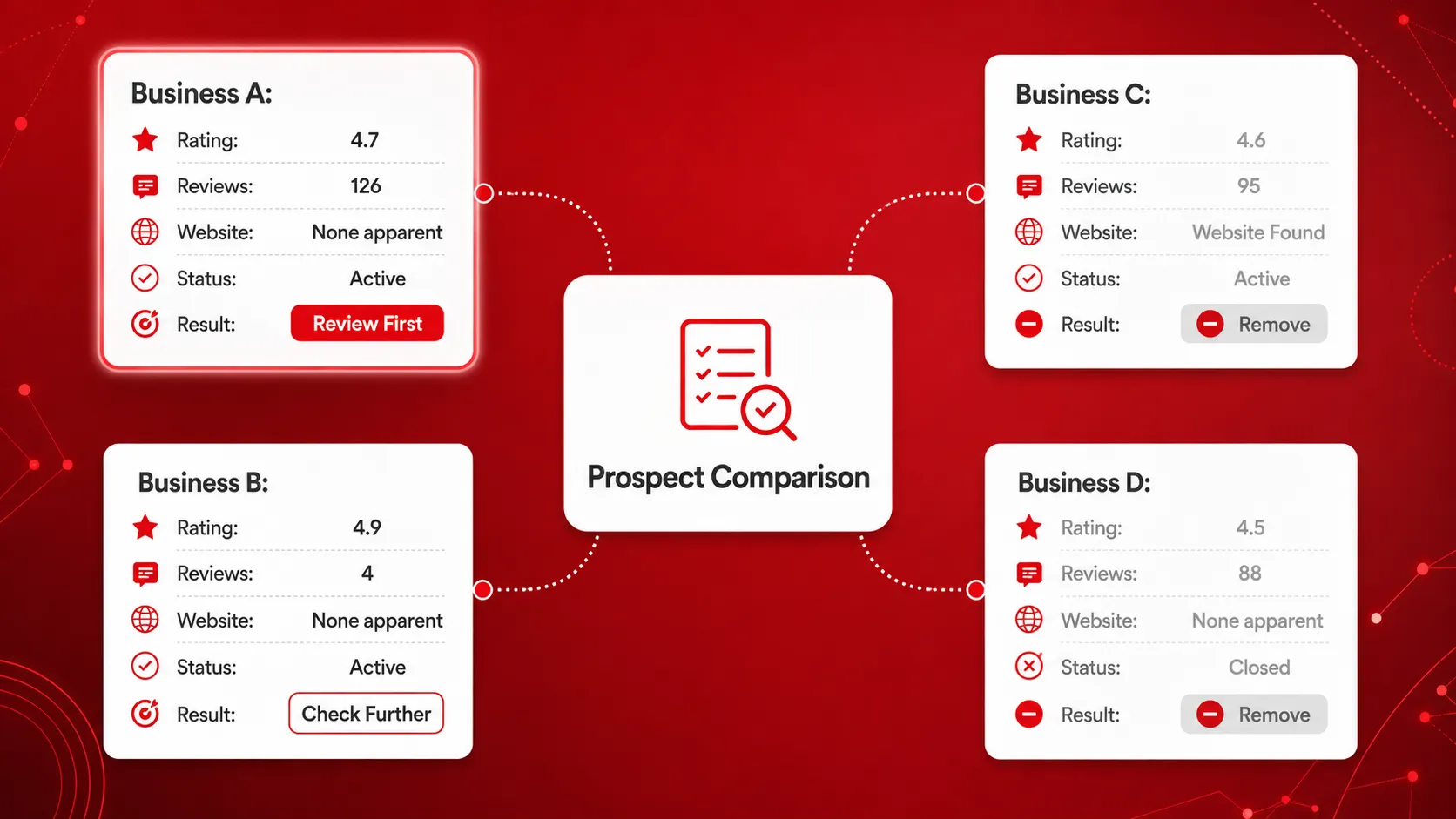
Business A combines several signals at once. It has a strong rating, a larger review count, active status, and no apparent website.
That does not make it a confirmed lead, but it gives you more reasons to check the business before moving on to weaker records.
Business B has the highest rating, but only four reviews.
That smaller review history gives you less information about customer activity. Before prioritizing it, check whether the business is new, whether reviews are recent, and whether it matches your target market.
Business C has strong reviews and is active, but a website is already present.
If your campaign specifically targets businesses without websites, this record no longer matches the core condition and can be removed from that list.
Business D has good historical reviews and no apparent website, but it is closed.
This shows why rating and website presence should not be reviewed alone. Business status needs to be checked before spending more time researching contact details or preparing outreach.
The comparison shows how several business signals can help narrow a broad list into a smaller group that deserves further research.
Matching your review and website criteria is only the first filter. Before adding a business to an outreach list, check whether the record still makes sense for your campaign.
A blank website field does not always mean the business has no website.
Search the business name and location to check whether an official site exists elsewhere. You may also find a website linked through a social profile, directory, or another business listing.
If a website already exists, remove the business from a campaign that specifically targets companies without websites.
Good historical reviews do not always mean the business is still active.
Check operating status and recent review activity before spending more time on the record. A business with recent reviews and an active status gives you more current information than one whose last customer feedback was several years ago.
A business should match more than a data filter.
For example, a web design agency may care about category, location, business size, current online presence, and whether its service makes sense for that type of company.
This helps prevent a list from becoming filled with businesses that technically match the search but are poor outreach targets
Before moving a business into an outreach list, check whether there is enough contact information for the next step.
Depending on your campaign, that may include a business phone number, email address, or other relevant contact details.
For the next stage, follow Targetron’s B2B contact verification workflow to check business and contact information before starting outreach.
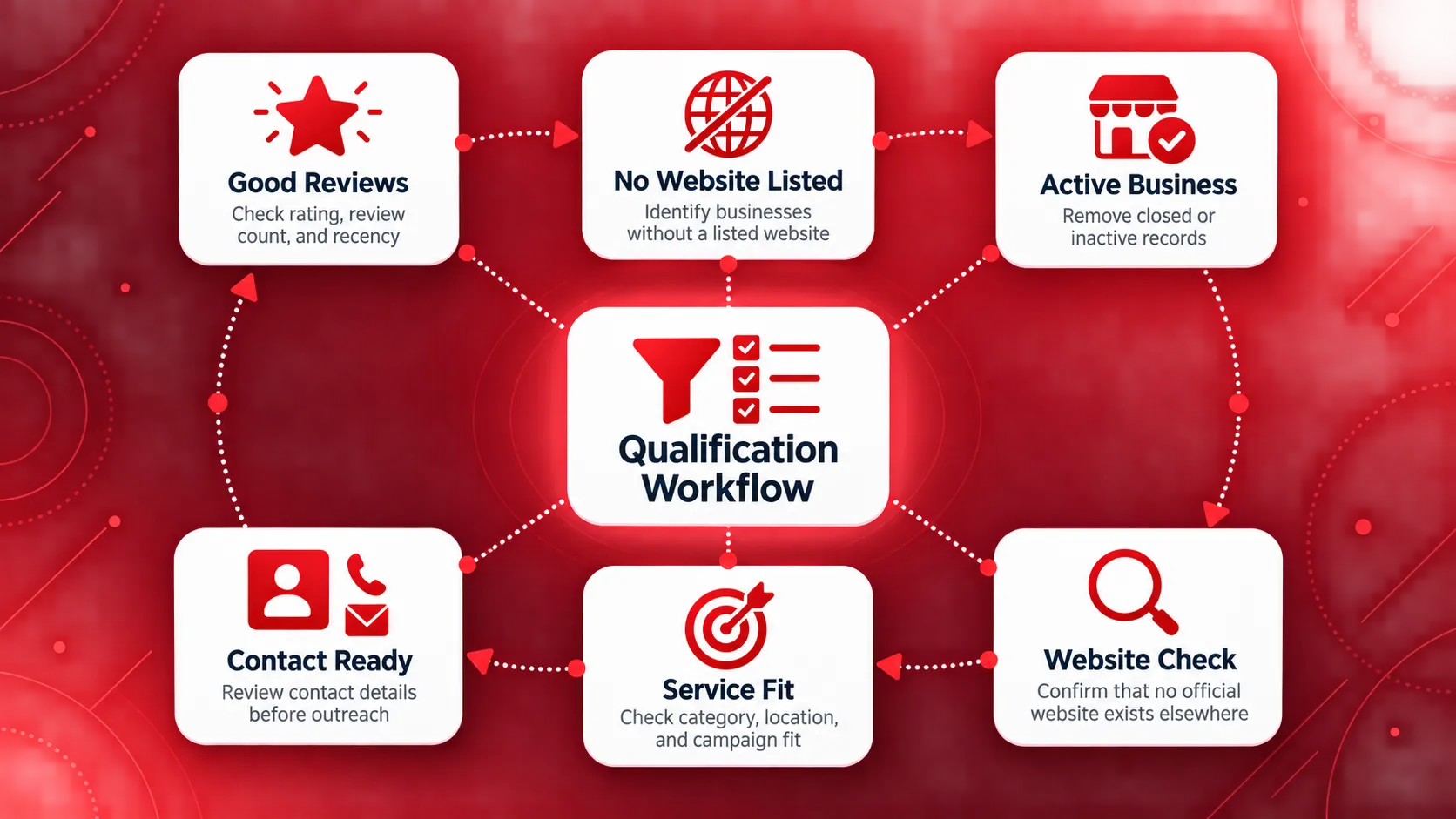
The result should be a smaller list of businesses that match your market, show current activity, have no confirmed website, and are practical to research or contact further.
Before adding a business to your prospect list, check that it meets the main conditions used throughout this workflow.
Don’t rely on one signal alone. Check the reviews, website status, business activity, and fit before deciding whether a business is worth adding to your prospect list.
For a broader qualification process, see how to find B2B leads that match your ICP using category, location, ratings, reviews, website signals, and contact paths.
Build a more focused prospect list with Targetron, then spend your time on businesses that are more relevant to your campaign instead of checking every record manually.
Most frequent questions and answers
This combination can help narrow a broad business list. Strong reviews can point to current customer activity, while no apparent website may indicate a gap worth checking.
It should still be treated as a research signal rather than proof that the business needs or wants a website.
There is no single rating or review-count threshold that works for every market.
A better approach is to compare businesses within the same category and location, then consider rating, review volume, and review recency together.
No. A business may have an official website that is missing from its listing or connected through another source.
Confirm the website status before adding the company to a no-website outreach list.
Not automatically.
A high rating can show positive customer feedback, but prospect quality also depends on business activity, market fit, website status, and whether the company matches your campaign.
Start by defining the category and location you want to target. Then compare rating, review count, and recent review activity before checking website presence and operating status.
Businesses that match several of these conditions can be reviewed first, while records that fail key checks can be removed from the list.
