Arrange a Free Consultation.
Get Free Expert Advice
Chat with Paul via WhatsApp now! Get a chance to receive free leads instantly.
The best way to find B2B leads without buying expensive lists is to build your own prospect source instead of relying on outdated spreadsheets.
Purchased lead lists may look fast, but they often create more work through bad-fit companies, old contact details, duplicate records, and weak targeting.
A better approach is to find leads from public business data, professional networking activity, review signals, company websites, hiring updates, competitor research, and tools like Targetron.
Instead of paying for a static list, you can build a focused prospect list based on category, location, business signals, website presence, reviews, and contact availability.
To find B2B leads without buying expensive lists, start by building your own prospect list from sources you can verify. Use public business data, professional networking activity, company websites, review signals, competitor research, and tools like Targetron to identify businesses that match your offer. Then filter each prospect by category, location, website presence, reviews, ratings, and contact availability before starting outreach.
A simple way to replace bought lead lists is to follow a Source → Signal → Shortlist → Outreach workflow.
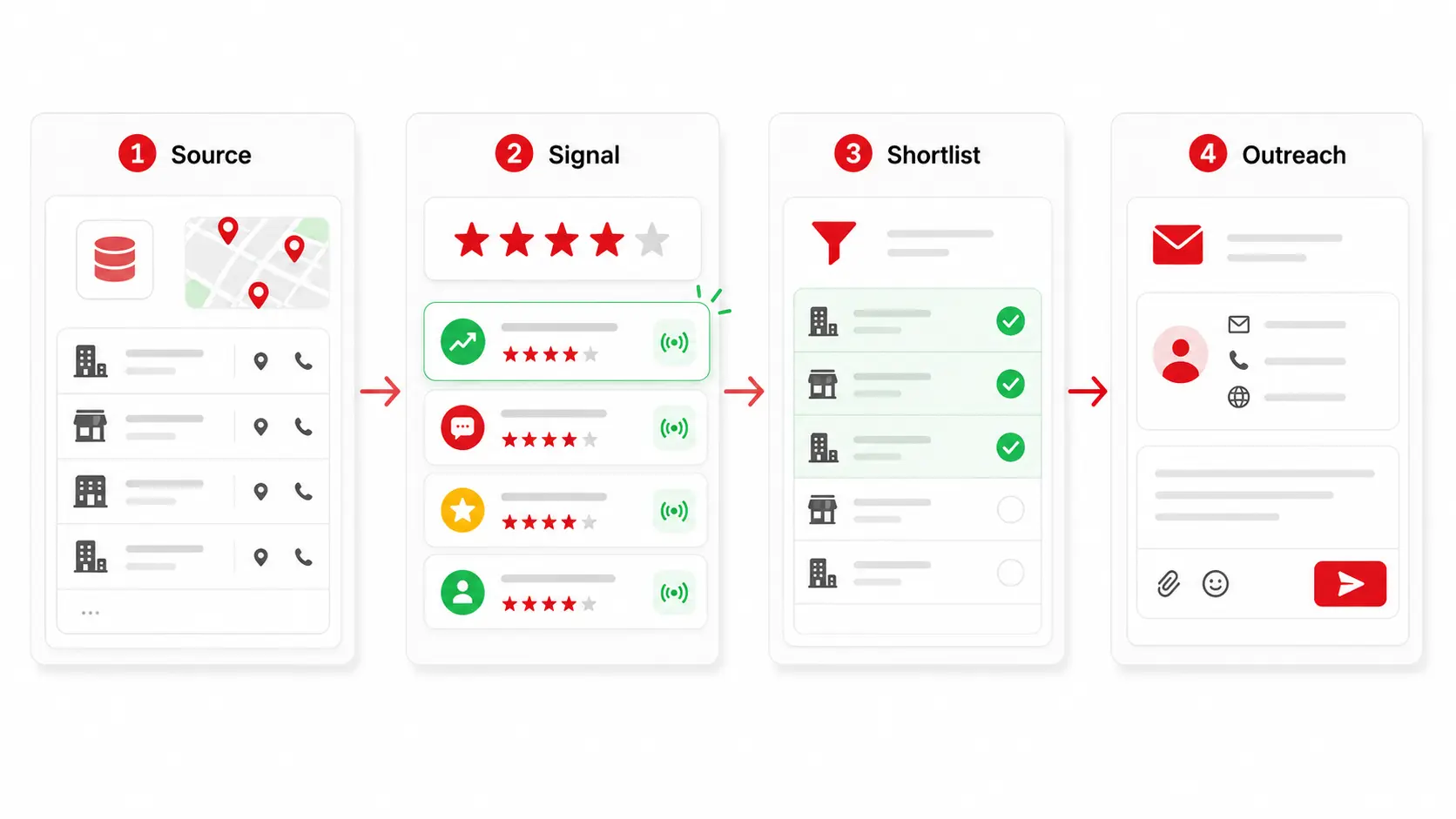
Buying lead lists looks convenient because they give you many contacts at once. But a large list does not always mean a useful list.
Many purchased lists include outdated emails, duplicate records, closed businesses, or companies that do not match your target market. Before your team can use the data, you still need to clean it, verify the details, and decide which businesses are worth contacting.
For small teams, the problem is not only data quality. They need a usable lead list fast enough to act on it.
The bigger problem is poor targeting.
A bought list may give you a company name, website, or email address, but it usually does not explain why that business is a good fit right now. It may not show useful signals such as weak reviews, missing websites, location fit, business category, or recent activity.
That is why many teams prefer to build their own lead lists from fresher sources. With tools like Targetron, you can search by category, location, reviews, ratings, website presence, and other public business signals.
Instead of starting with a random spreadsheet, you can build a focused prospect list based on businesses that match your offer and have a clearer reason for outreach.
If you already have an ideal customer profile, the next step is to find B2B leads that match your ICP before exporting the list.
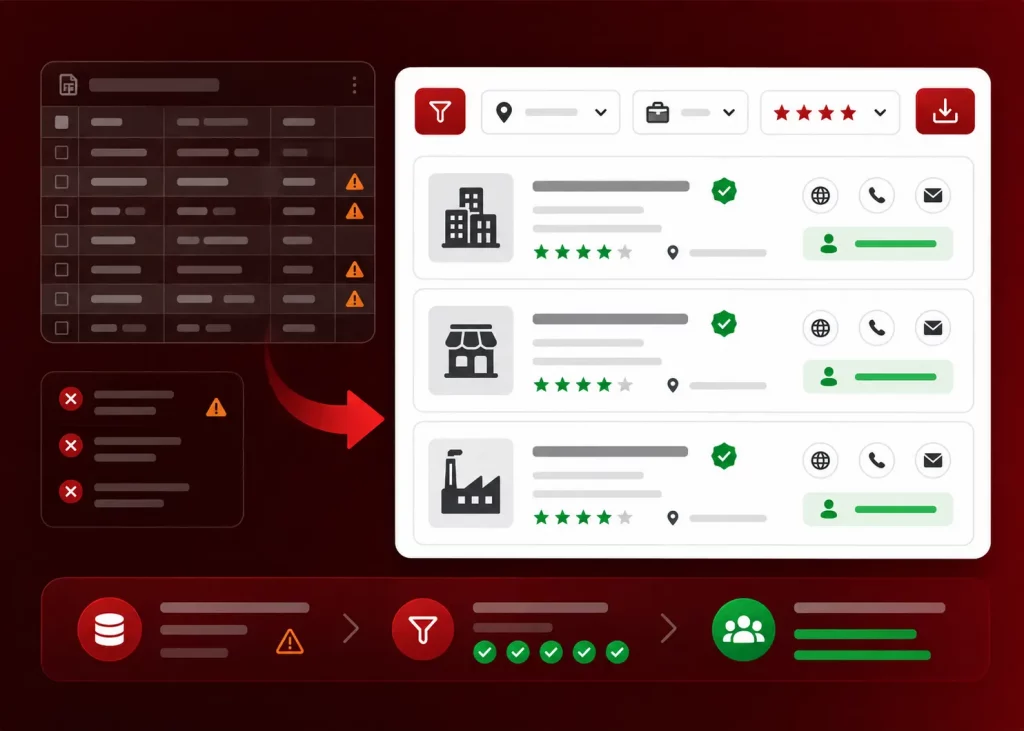
Instead of relying on outdated spreadsheets, use Targetron to find businesses by category, location, reviews, ratings, and website presence before you start outreach.
Once you understand the limits of bought lists, the next step is to build your own prospect list from sources and signals you can verify.
The best alternative to buying lead lists is to build your own list from sources you can check and update.
Start with public places where your target customers already leave useful signals. This can include LinkedIn, company websites, business directories, review platforms, Google Maps data, and competitor audiences.
Professional networking platforms can help you find people by job title, company type, industry, location, and recent activity. For example, you can search for founders, operations managers, sales leaders, or local business owners in your target niche.
Public business data can also help you qualify companies before outreach. Instead of working from a static spreadsheet, you can check signals such as business category, location, website presence, phone number, ratings, reviews, and customer complaints.
This is especially useful when you need coverage across a specific city, category, service area, or local market.
Targetron can support the process. You can search for businesses by category and location, then review public signals that show whether a company is worth contacting.
This helps small teams move from manual research to a usable prospect list faster, without waiting for a VA, a data provider, or a custom scraping setup.
Competitor audiences can also reveal demand. Look at public case studies, comments on social and professional networking platforms, review platforms, communities, webinars, and partner pages to understand which types of companies are already interested in your category.
When you combine these sources, you can build a cleaner prospect list based on fit, activity, and visible business signals instead of buying a random spreadsheet.
Targetron helps you move from manual research to a usable prospect list faster. Find local businesses, review public signals, and shortlist better-fit prospects without starting from a random spreadsheet.
A better lead list is not only based on what the business is. It is also based on what is happening in the business right now.
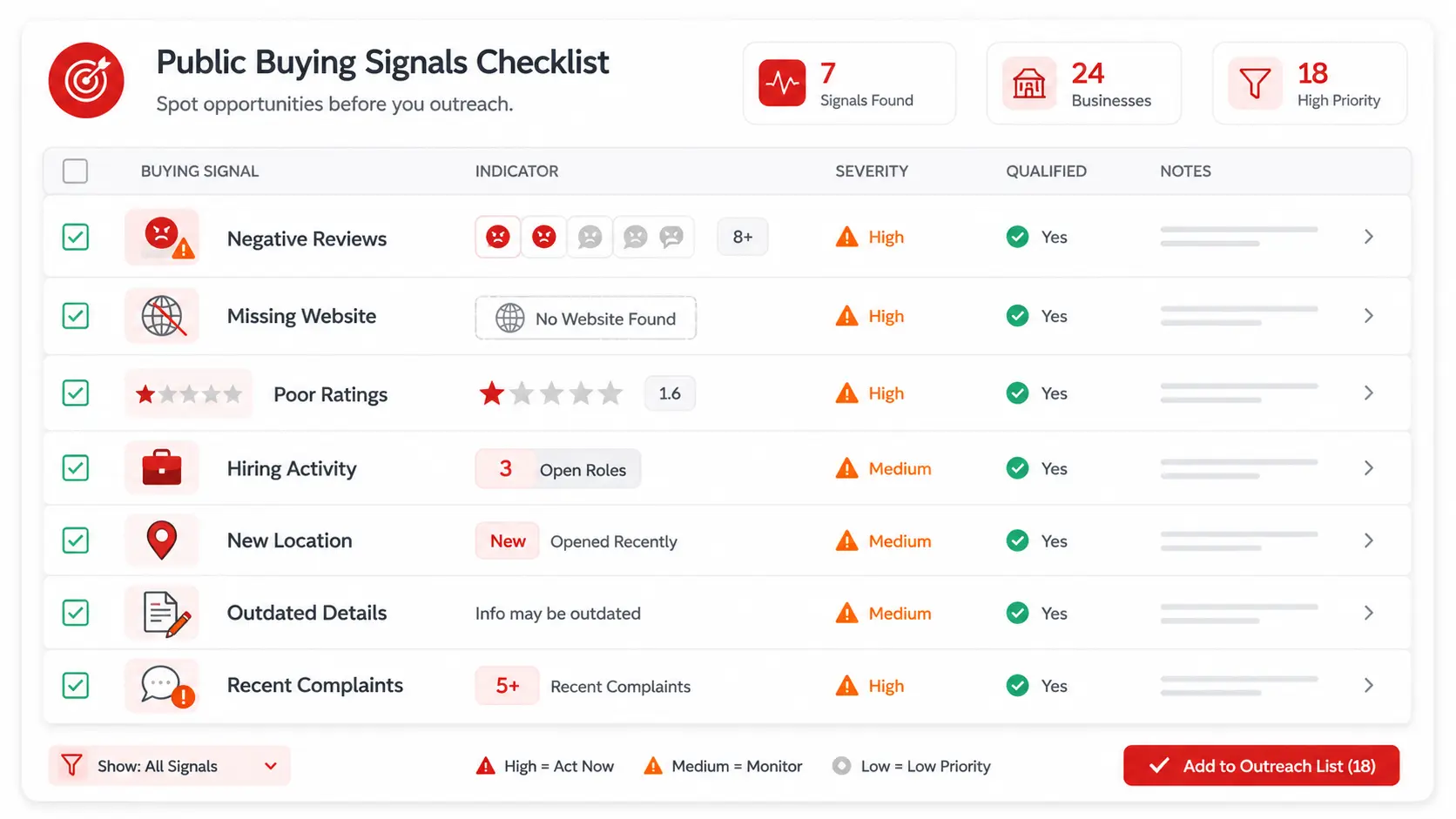
Buying signals are public clues that a company may have a current need, problem, or reason to spend money.
For example, a business may be worth contacting if it is:
These signals make your outreach more relevant. Instead of sending a generic message, you can connect your offer to something visible and specific.
For example, a marketing agency could contact businesses with weak online visibility. A reputation management service could contact companies with recent negative reviews. A software company could focus on businesses that are growing but still using manual processes.
This is why tools like Targetron are useful for B2B lead generation. You can start with a category and location, then look for signals such as ratings, reviews, website presence, and business details before deciding who to contact.
This keeps your outreach tied to a real business reason, not just a name in a spreadsheet. When your list is based on visible business signals, your message becomes easier to personalize and more useful to the prospect.
After you have a clearer way to find and qualify prospects, relationships, content, and AI can help you turn that research into better conversations.
Not every B2B lead has to come from a database. Some leads come from trust, useful content, and repeated visibility in the right market.
The key is to connect your relationship-building with real business signals.
For example, if you use Targetron to find local businesses with poor reviews, missing websites, low ratings, or weak online visibility, those patterns can become useful content ideas. You can create a checklist, short guide, audit template, or professional networking post that explains the problem and how businesses can fix it.
Instead of writing generic content about “getting more leads,” focus on specific problems your prospects already recognize, such as:
This also makes referrals easier. Instead of asking, “Do you know anyone who needs leads?” ask a more specific question:
“Do you know any agency owners, consultants, or local service businesses that still build prospect lists manually?”
That type of question is easier to answer because it describes a real situation.
When relationships and content are based on visible business signals, lead generation becomes less random. You are not just asking for attention. You are showing that you understand a problem in the market.
AI can help you research B2B leads faster, but it should not be used to contact everyone without checking the list first.
The best use of AI is to organize, summarize, and improve your prospect research.
For example, you can use AI to:
A simple workflow can look like this:
This keeps the process efficient without turning it into spam.
AI can help you move faster, but the quality still depends on your targeting. A small, well-filtered list with a clear reason for outreach is usually better than a large list of random contacts.
You do not need to use every method at once. Start with one target market, one clear offer, and one repeatable lead research process.
Here is a simple 30-day plan:
| Week | Focus | What to Do |
|---|---|---|
| Week 1 | Define your target | Choose one industry, location, buyer type, and problem you want to solve. |
| Week 2 | Build your first list | Use professional network, Targetron, public business data, competitor research, and company websites. |
| Week 3 | Add qualification signals | Check reviews, ratings, website presence, business category, recent activity, and contact details. |
| Week 4 | Start outreach | Contact only the best-fit prospects with a message based on a visible business signal. |
The goal is to keep the process focused.
Do not build a huge list right away. Start with a smaller group of businesses that clearly match your offer. Then clean the list, remove poor-fit companies, and improve your outreach based on replies.
A simple lead generation sprint should answer three questions:
This helps you avoid random outreach and build a lead list that improves over time.
Building your own lead list gives you more control, but the process can still fail if the data is not filtered properly.
The biggest mistake is collecting too many leads too quickly. A large list may look impressive, but it becomes hard to use if the businesses do not match your offer.
A lead list is only useful if the data is clean enough to review, segment, export, and use in your outreach workflow.
Avoid these common mistakes:
A smaller, cleaner list is usually better than a large list filled with weak prospects.
This does not mean paid lists are always useless. Buying a list can make sense when you need broad market research, enterprise account mapping, or extra contact enrichment for companies you already want to reach.
But the list should not replace your qualification process.
Even if you use a paid data source, you still need to check whether each company fits your market, has a relevant need, and gives you a clear reason for outreach.
The best lead generation system combines quality data, useful signals, and human judgment. That is how you find better B2B leads without depending on expensive lists alone.
The best way to find B2B leads without buying expensive lists is to build a prospecting process you can control.
Bought lists may give you contacts quickly, but they often lack freshness, context, and targeting. A better approach is to use public business data, professional network research, reviews, competitor signals, referrals, content, and AI-assisted research to find companies that match your offer.
A useful lead list is not measured by size alone. It is measured by fit, timing, and the reason for outreach.
Tools like Targetron can help by making public business research easier. Instead of manually checking businesses one by one, you can search by category, location, reviews, ratings, website presence, and other useful signals.
Start small. Choose one market, build a focused list, qualify each business, and improve your outreach based on real responses.
To find B2B leads without buying expensive lists, follow this simple workflow:
That is how you create a lead generation system that is more targeted, more flexible, and less dependent on expensive bought lists.
Most frequent questions and answers
You can find B2B leads without buying expensive lists by building your own prospect list from sources you can verify. Start with public business data, LinkedIn activity, company websites, review signals, business directories, and tools like Targetron. Then filter businesses by category, location, website presence, reviews, ratings, and other signals that show whether they are worth contacting.
Bought lead lists often include outdated emails, duplicate records, poor-fit companies, or businesses that no longer match your target market. Even after buying the list, your team still needs to clean the data, verify the details, and decide which prospects are actually relevant.
Useful signals include business category, location, website presence, ratings, review count, negative reviews, recent activity, phone number availability, hiring activity, and signs of business growth. These signals help you understand why a company may be a good fit before you contact them.
Targetron helps you find businesses by category and location, then review public business signals before outreach. Instead of manually searching one business at a time, you can use Targetron to build a more focused prospect list based on visible details like reviews, ratings, website presence, and business information.
A smaller, cleaner lead list is usually better than a large list filled with weak prospects. The best list is not the one with the most rows. It is the one with businesses that match your offer, show relevant signals, and give you a clear reason for outreach.
